
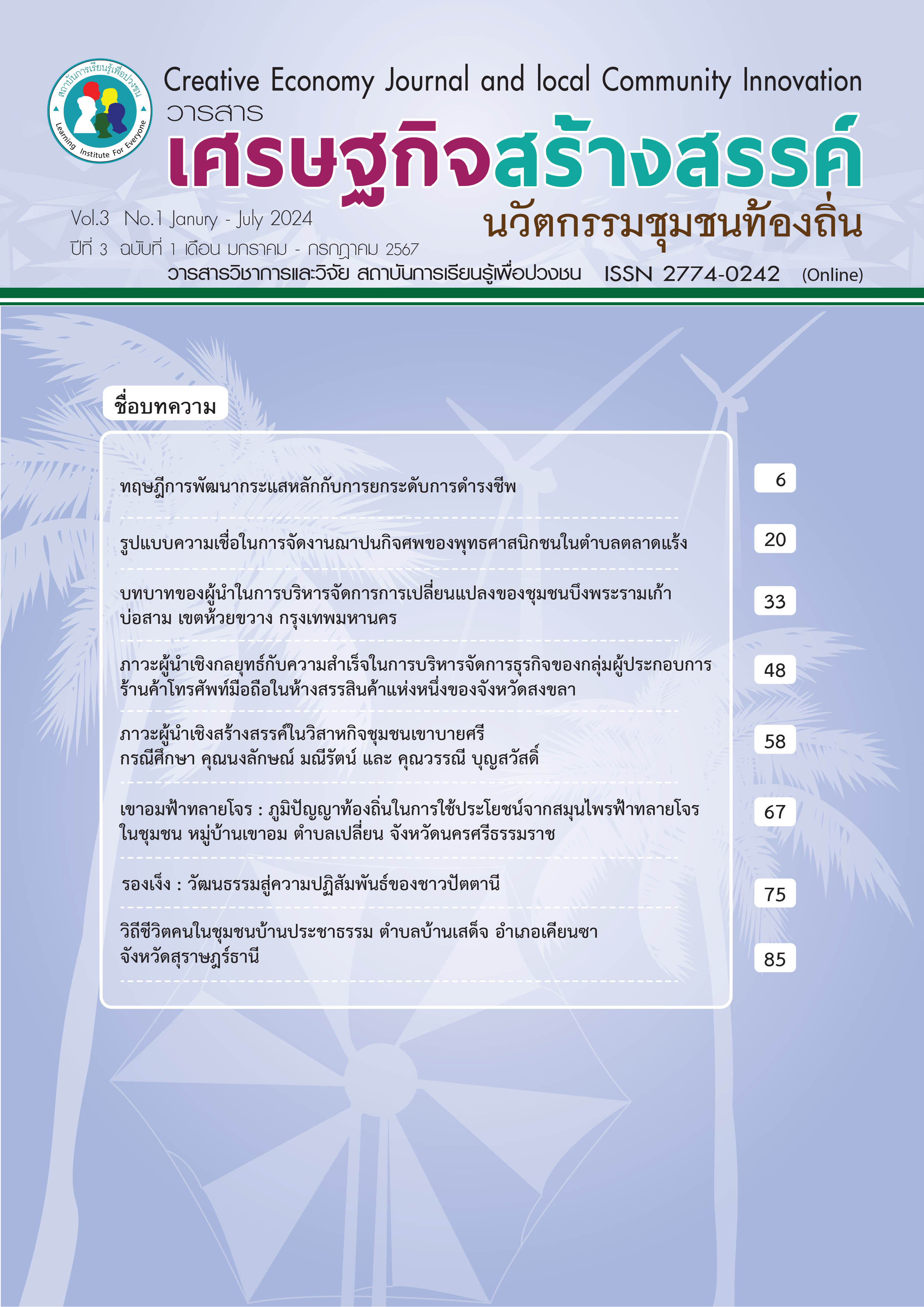
ทฤษฎีการพัฒนากระแสหลักกับการยกระดับการดำรงชีพ
คำสำคัญ:
การเคลื่อนไหวทางสังคม, การพัฒนาทางเศรษฐกิจ, การดำรงชีพอย่างยั่งยืนบทคัดย่อ
ประเทศไทยเริ่มมีแผนพัฒนาเศรษฐกิจที่มีรูปแบบสอดรับกับการพัฒนากระแสหลักมานับตั้งแต่หลังสงครามโลก ครั้งที่ 2 และปัจจุบันประเทศไทยขับเคลื่อนด้วยแผนพัฒนาเศรษฐกิจและสังคมแห่งชาติฉบับที่ 13 (พ.ศ. 2566 – 2570) แต่พบว่า ความเหลื่อมล้ำระหว่างคนรวยกับคนจนกลับยิ่งมีช่องว่างเพิ่มสูงขึ้น แม้ว่ามาตรฐานการดำรงชีพเริ่มมีการพูดถึงในทฤษฎีการพัฒนา เพื่อให้แนวคิดการดำรงชีพอย่างยั่งยืนเป็นแนวทางของพัฒนาทางเลือกในประเทศไทยได้กว้างขวางมากยิ่งขึ้น บทความนี้จึงได้เสนอกรอบแนวคิดการดำรงชีพอย่างยั่งยืนในมิติของสินทรัพย์ 5 องค์ประกอบ สินทรัพย์มนุษย์, สินทรัพย์ทางสังคม, สินทรัพย์ธรรมชาติ, สินทรัพย์ทางกาย, สินทรัพย์การเงิน เพื่อกำหนดยุทธวิธีการดำรงชีพ ปรับเปลี่ยนกระบวนการและโครงสร้าง และสามารถยกระดับมาตรฐานการดำรงชีพสอดรับกับการพัฒนา กระแสหลักที่มาจากการมีส่วนร่วมของชุมชน โดยมีคนเป็นศูนย์กลางและรู้สึกถึงความมั่นคงปลอดภัยในชีวิต มีสุขภาพจิตที่ดี เป็นการพัฒนาอย่างยั่งยืนที่ไม่มุ่งเน้นแต่เฉพาะด้านเศรษฐกิจแต่เพียงอย่างเดียว แต่ต้องคำนึงถึงสังคมและสิ่ง แวดล้อมควบคู่ไปด้วยกัน ซึ่งจะมีผลต่อการปรับปรุงการดำรงชีพในมิติต่าง ๆ จนสามารถยกระดับการพึ่งตนเองทางเศรษฐกิจ มีการปรับยุทธวิธีการดำรงชีพที่มีแนวโน้มความยั่งยืน เนื่องจากสามารถลดความเปราะบางและเพิ่มประสิทธิภาพในการจัดการสินทรัพย์ที่เกี่ยวข้องกับการดำรงชีพในระดับครัวเรือน และนำไปสู่การลดความเหลื่อมล้ำ ด้วยการพัฒนาที่ยั่งยืนผ่านการมีส่วนร่วมของชุมชน
เอกสารอ้างอิง
Abu-Saifan, S. (2012). Social Entrepreneurship: Definition and Boundaries. Technology Innovation Management Review, 2(2): 22-27. http://doi.org/10.22215/timreview/523
Aghion P, Howitt P. (1998). Endogenous Growth Theory. Cambridge, MA: MIT Press; 1998.
Anríquez, Gustavo & Stamoulis, Kostas. (2007). “Rural development and poverty reduction: is agriculture still the key?,” ESA Working Papers 289048, Food and Agriculture Organization of the United Nations, Agricultural Development Economics Division (ESA).
Bhandari PB. (2013). Rural livelihood change? Household capital, community resources and livelihood transition. J Rural Stud. 2013 Oct 1;32:126-136. doi: 10.1016/j.jrurstud.2013.05.001. PMID: 24043919; PMCID: PMC3772533.
Burt, R. S. (2015). Reinforced structural holes. Social Networks, 43, 149-161. doi:10.1016/j.socnet.2015.04.008
Chambers, R., & Conway, G. (1991). Sustainable rural livelihoods: practical concepts for the 21st century. IDS Discussion Paper, 296, 1-29. doi:ISBN 0 903715 58 9
Credit Suisse AG. (2023). The Global Wealth Report 2023. Retrieved December 30, 2023 from https://www.credit-suisse.com/about-us/en/reports-research/global-wealth-report.html
Diani, M. (1992). The Concept of Social Movement. The Sociological Review, 40(1), 1-25. https://doi.org/10.1111/j.1467-954X.1992.tb02943.x
DFID. (1999). Sustainable Livelihoods Guidance Sheets Framework Introduction Vulnerability Transforming. Context, 26-26. doi:10.1002/smj
DFID. (2008). DFID ’ s Sustainable Livelihoods Approach and its Framework. Development, 1-5.
Eversole, R., Barraket, J., & Luke, B. G. (2013). Social enterprises in rural community development. Community Development Journal, 49(2), 245-261. doi:10.1093/cdj/bst030
El Ebrashi, R. (2013). Social entrepreneurship theory and sustainable social impact. Social Responsibility Journal, 9(2), 188-209. doi:10.1108/srj-07-2011-0013
Frank, Ellis. (2008). The Determinants of Rural Livelihood Diversification in Developing Countries. Journal of Agricultural Economics, 51(2):289-302. doi: 10.1111/J.1477-9552.2000.TB01229.X
Farmer, J., De Cotta, T., McKinnon, K., Barraket, J., Munoz, S.-A., Douglas, H., & Roy, M. J. (2016). Social enterprise and wellbeing in community life. Social Enterprise Journal, 12(2), 235-254. doi:10.1108/sej-05-2016-0017
Masae, A. (2013). Structural Change and Natural Resource-based Livelihood Adjustment among Wetland Settlers in Southern Thailand. (1), 57-67.
Montgomery, A. W., Dacin, P. A., & Dacin, M. T. (2012). Collective Social Entrepreneurship: Collab oratively Shaping Social Good. Journal of Business Ethics, 111(3), 375-388. doi:10.1007/s10551-012-1501-5
Nishikawa, Y. (2010). Human Security in Southeast Asia (1st ed.). Routledge. https://doi.org/10.4324/9780203850459
Maneein, D. (2023). Community-Based Social Entrepreneurshiip and Rural Livelihood Improvement. Graduate School of Social Development and Management Strategy. National Institute of Development Administration
Krantz, L. (2001). The sustainable livelihood approach to poverty reduction. Division for Policy and Socio-Economic Analysis(February), 44-44.
Pearce, J. (2009). Social economy: engaging as a third system? The Social Economy International Perspectives on Economic Solidarity, 22-36.
Peredo, A. M., & Chrisman, J. J. (2006). Toward a Theory of Community-Based Enterprise. Academy of Management Review, 31(2), 309-328. doi:10.5465/amr.2006.20208683
Pongsapich, A. & Kuwinpant, P. (2002). Patronage system (in Thai). Bangkok: Chulalongkorn University Printing House.
Rostow, W. W. (1960). The stages of economic growth: A non-communist manifesto. Cambridge: Cambridge University Press.
Tan, G. (2007). The next NICS of Asia. Third World Quarterly, 14(1), 57-73. doi:10.1080/01436599308420313
Todaro, P. M. (1994). Economic development (5th ed.). New York: Longman Publishers.
United Nations (2023). The Global Sustainable Development Report 2023. Retrieved December 30, 2023 from https://sdgs.un.org/gsdr/gsdr2023
United Nations Development Programme (1994). The Human Development Report 1994. Retrieved December 30, 2023 from https://hdr.undp.org/content/human-development-report-1994
United Nations Development Programme (2023). Making Our Future:
New Directions for Human Development in Asia and the Pacific.Retrieved December 30, 2023. from https://www.undp.org/sites/g/files/zskgke326/files/2023-11/undp_regional_human_development_report_web_final_0.pdf
ดาวน์โหลด
เผยแพร่แล้ว
รูปแบบการอ้างอิง
ฉบับ
ประเภทบทความ
สัญญาอนุญาต

อนุญาตภายใต้เงื่อนไข Creative Commons Attribution-NonCommercial-NoDerivatives 4.0 International License.
##default.contextSettings.thaijo.licenseTerms##

