From Fair Trade to ESG Circular Philanthropy
A Multi-Level Framework for Sustainable Value Co-Creation and Social Impact Governance
Keywords:
ESG, Circular Philanthropy, Fair Trade, Sustainability, SDGs, Stakeholder Theory, SDG Bootcamp; Social Impact Assessment; Sustainability Education; ESG Education; Social Return on Investment (SROI); Theory of Change; SDG Evaluation Framework, SROIAbstract
This study develops a comprehensive conceptual framework that reconceptualizes traditional Fair Trade
practices within an Environmental, Social, and Governance (ESG) paradigm through the lens of circular
philanthropy. While Fair Trade has contributed significantly to ethical sourcing and equitable exchange,
its impact remains largely linear, transactional, and constrained in scalability. In contrast, ESG
frameworks provide a broader governance structure but often lack embedded mechanisms for
continuous social value circulation and impact feedback.
To address these gaps, this paper proposes the ESG Circular Philanthropy (ESG-CP) framework, which
integrates stakeholder theory, the triple bottom line, and social impact assessment into a recursive
system of value co-creation. The framework conceptualizes social impact across multiple levels—
cognitive, behavioral, organizational, and systemic—and links them through circular feedback loops that
enable continuous learning and adaptive governance.
Full-text and current issue available at ESG Frontier: https://so17.tci-thaijo.org/index.php/ESGF/about/index
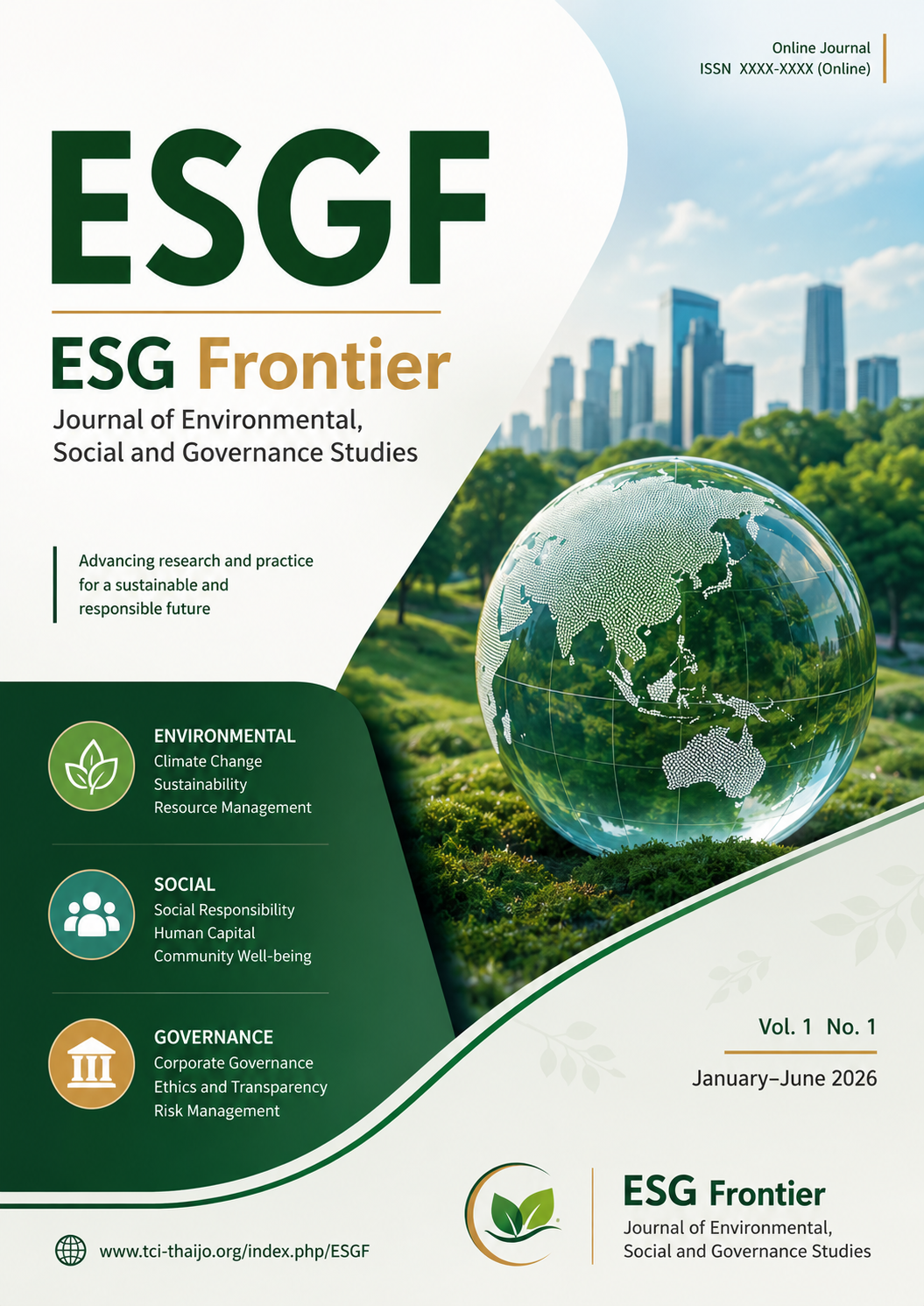
ESG Frontier
Journal of Environmental, Social and Governance Studies
Vol. 1, No. 1 (January–June 2026) | Online
This study contributes to the literature in three ways. First, it bridges Fair Trade and ESG paradigms by
extending ethical trade into a dynamic sustainability governance model. Second, it introduces circularity
into philanthropic and social impact processes, shifting from one-way value transfer to regenerative
systems. Third, it offers a scalable and theoretically grounded model aligned with Sustainable
Development Goals (SDGs).
2
The findings provide implications for both theory and practice, particularly in ESG reporting, impact
measurement, and the design of sustainable value ecosystems. Future research should empirically
validate the framework and develop operational indicators for multi-level impact assessment.
References
Becker, G. S. (1964). Human Capital.
Elkington, J. (1997). Cannibals with Forks: The Triple Bottom Line of 21st Century Business.
Nicholls, A., Opal, C., & others. (2012). Fair Trade: Market-Driven Ethical Consumption.
Vanclay, F. (2003). International principles for social impact assessment.
United Nations. (2015). Transforming Our World: The 2030 Agenda for Sustainable Development.
UNESCO. (2017). Education for Sustainable Development Goals.
Downloads
Published
How to Cite
Issue
Section
License
Copyright (c) 2026 ESG Frontier

This work is licensed under a Creative Commons Attribution-NonCommercial-NoDerivatives 4.0 International License.
Articles in this journal are copyrighted by the x may be read and used for academic purposes, such as teaching, research, or citation, with proper credit given to the author and the journal.use or modification of the articles is prohibited without permission.
statements expressed in the articles are solely the opinions of the authors.
authors are fully responsible for the content and accuracy of their articles.
other reuse or republication requires permission from the journal."

