
Empowering the Elderly School to Improve Health: A Case Study of the Wat Pa Tan Elderly School
Abstract
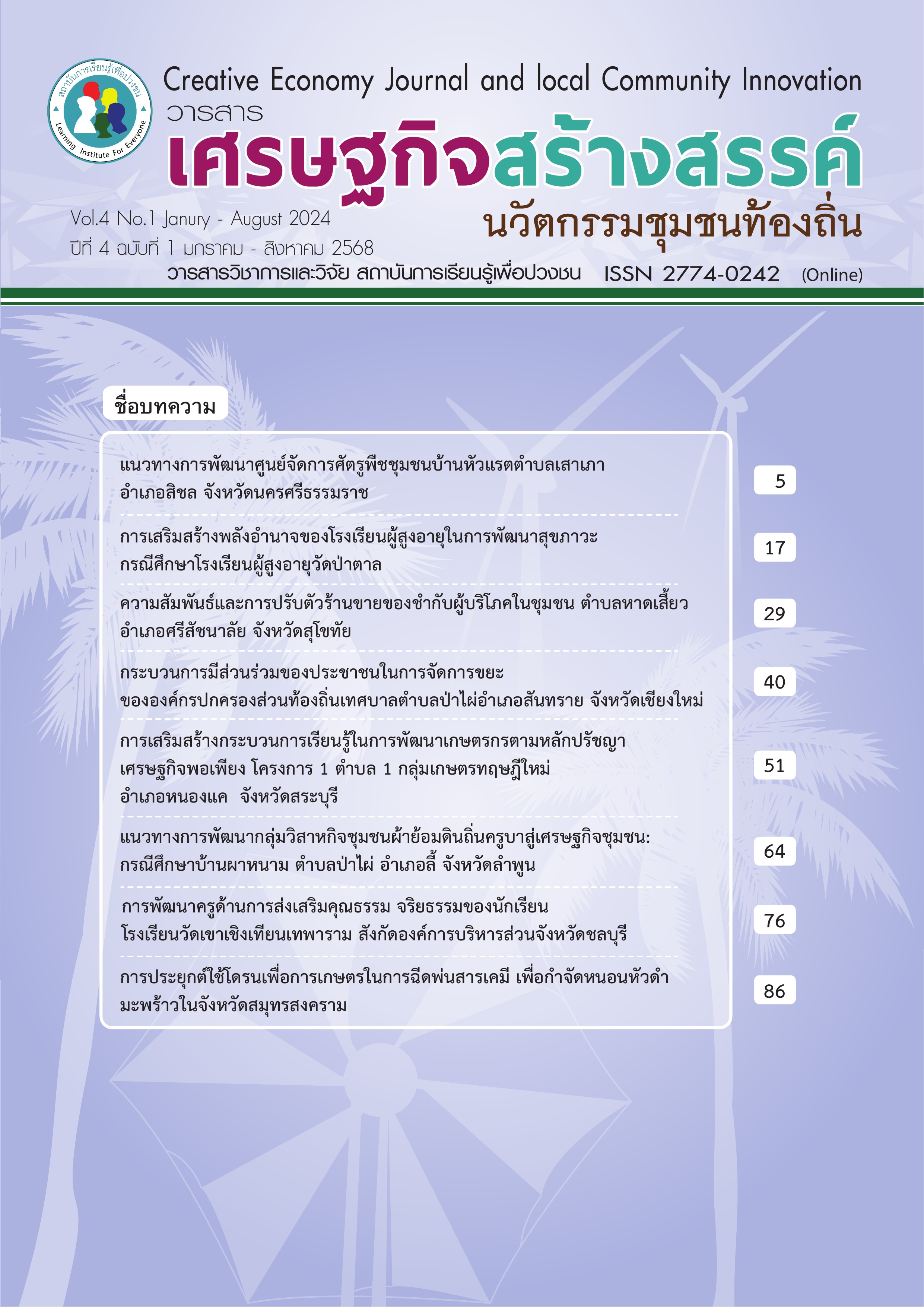
This research aimed to: 1) investigate the problems, obstacles, and roles of the Wat Pa Tan Elderly School; 2) examine the development of empowerment in designing a health and well-being curriculum for the School; and 3) examine the effects of empowerment on the Wat Pa Tan Elderly School. This qualitative study employed a participatory action research approach. Data were collected through in-depth interviews, focus group discussions, and observations involving 86 participants associated with the Wat Pa Tan Elderly School. The data were analyzed using content analysis and interpreted in relation to relevant concepts and theories of empowerment.
The findings revealed two categories of key success factors: internal and external factors. The internal factors comprised: 1) trust and respect for key personnel, including the abbot of Wat Pa Tan, former community leaders, and retired civil servants serving on the committee, whose credibility provided psychological support to the participants; 2) dedicated volunteer mentors who coordinated with all relevant sectors and designed learning processes and activities; and 3) diverse learners and the continuous admission of new members each year, which stimulated active learning, generated new ideas and activities, and encouraged experienced members to become mentors for subsequent cohorts.
The external factors included empowering the School to manage its activities independently and emphasizing integrated teaching and learning through collaboration with various networks in Buak Khang Subdistrict. Support included guest speakers and partial funding from Buak Khang Subdistrict Municipality, as well as the use of elderly learners’ local wisdom to promote mutual knowledge exchange.
The internal and external empowerment of the Wat Pa Tan Elderly School enhanced the capabilities of its committee members, volunteer mentors, and elderly learners. It increased their confidence, strengthened their decision-making abilities, and enabled them to transfer knowledge and facilitate learning processes. The School’s curriculum was designed to align its operations toward the shared goal of improving learners’ physical, mental, social, and intellectual well-being. The elderly learners enjoyed participating in activities together and were able to apply what they had learned in their daily lives.
References
กรมกิจการผู้สูงอายุ. (ม.ป.ป.-ก). *คู่มือสิทธิผู้สูงอายุตามพระราชบัญญัติผู้สูงอายุ พ.ศ. 2546.* สืบค้น 12 กุมภาพันธ์ 2566, จาก https://www.dop.go.th/th/laws/2/10/787
กรมกิจการผู้สูงอายุ. (ม.ป.ป.-ข). *แผนปฏิบัติการด้านผู้สูงอายุ ระยะที่ 3 (พ.ศ. 2566–2580).* สืบค้น 18 พฤษภาคม 2566, จาก https://www.dop.go.th/th/laws/1/28/843
กรมกิจการผู้สูงอายุ. (ม.ป.ป.-ค). *แผนผู้สูงอายุแห่งชาติ ฉบับที่ 2 (พ.ศ. 2545–2564) ฉบับปรับปรุงครั้งที่ 1 พ.ศ. 2552.* สืบค้น 24 มิถุนายน 2556, จาก https://www.dop.go.th
กรมกิจการผู้สูงอายุ. (ม.ป.ป.-ง). *มาตรการขับเคลื่อนระเบียบวาระแห่งชาติ เรื่อง สังคมผู้สูงอายุ.* สืบค้น 24 กุมภาพันธ์ 2566, จาก https://www.dop.go.th/th/laws/1/35
กรมกิจการผู้สูงอายุ. (ม.ป.ป.-จ). *มติสมัชชาผู้สูงอายุระดับชาติ ปี 2564: สังคมสูงวัย คนไทยอายุยืน.* สืบค้น 1 มีนาคม 2566, จาก https://www.dop.go.th/th/laws/1/35840
กรมส่งเสริมการปกครองท้องถิ่น. (2566). *คู่มือแนวทางการขับเคลื่อนเครือข่ายโรงเรียนผู้สูงอายุแห่งประเทศไทย.*
กระทรวงศึกษาธิการ. (2566). *รวมกฎหมาย ประกาศ และระเบียบที่ออกตามความในพระราชบัญญัติผู้สูงอายุ พ.ศ. 2546 และที่แก้ไขเพิ่มเติม รวมถึงกฎหมายอื่นที่เกี่ยวข้อง.* https://www.moe.go.th
คณะนิติศาสตร์ จุฬาลงกรณ์มหาวิทยาลัย. (ม.ป.ป.). *ศูนย์รวมกฎหมายเกี่ยวกับผู้สูงอายุ.* สืบค้น 15 พฤษภาคม 2566, จาก https://www.law.chula.ac.th
จักรแก้ว นามเมือง. (2560). *โรงเรียนผู้สูงอายุ: ต้นแบบการจัดการสุขภาวะและสวัสดิการผู้สูงอายุ* (รายงานการวิจัยเลขที่ MCU RS6107600070). มหาวิทยาลัยมหาจุฬาลงกรณราชวิทยาลัย วิทยาเขตพะเยา.
ทวีทอง หงส์วิวัฒน์. (2527). *การมีส่วนร่วมของประชาชนในการพัฒนา.* ศูนย์ศึกษานโยบายสาธารณสุข มหาวิทยาลัยมหิดล.
นรินทร์ชัย พัฒนพงศา. (2546). *การมีส่วนร่วม: หลักการพื้นฐาน เทคนิค และกรณีตัวอย่าง* (พิมพ์ครั้งที่ 2). สิริลักษณ์การพิมพ์.
มงคลกิตติ์ โวหารเสาวภาคย์ และคณะ. (2561). *โรงเรียนผู้สูงอายุ: องค์ประกอบ รูปแบบ การพัฒนาหลักสูตร และกิจกรรมเพิ่มสุขภาวะผู้สูงอายุ* (รายงานการวิจัยเลขที่ MCU RS610761174). มหาวิทยาลัยมหาจุฬาลงกรณราชวิทยาลัย วิทยาเขตพะเยา.
รังสิมา เดชกำแหง. (2561). *กระบวนการบริหารจัดการโรงเรียนผู้สูงอายุและสื่อกิจกรรมการเรียนรู้: กรณีศึกษาโรงเรียนผู้สูงอายุเทศบาลเมืองวังน้ำเย็น อำเภอวังน้ำเย็น จังหวัดสระแก้ว.* สาขาวิชาศิลปะชนบทศึกษาเพื่อการพัฒนา วิทยาลัยพัฒนศาสตร์ ป๋วย อึ๊งภากรณ์ มหาวิทยาลัยธรรมศาสตร์.
วชิรวัชร งามละม่อม. (2559). *ทฤษฎีการมีส่วนร่วม.* สืบค้น 22 พฤศจิกายน 2565, จาก https://learningofpublic.blogspot.com
สำนักงานคณะกรรมการสุขภาพแห่งชาติ. (2550). *พระราชบัญญัติสุขภาพแห่งชาติ พ.ศ. 2550* (พิมพ์ครั้งที่ 2). สหพัฒนไพศาล.
อคิน รพีพัฒน์. (2527). *การมีส่วนร่วมของชุมชนในการพัฒนาชนบทในสภาพสังคมและวัฒนธรรมไทย.* ศูนย์ศึกษานโยบายสาธารณสุข มหาวิทยาลัยมหิดล.
อิศราภรณ์ ชมชื่น. (2556). *ปัจจัยที่มีความสัมพันธ์กับการสร้างเสริมพลังทางสังคม (Social empowerment) ของประชาชนในเขตกรุงเทพมหานคร* [วิทยานิพนธ์ศิลปศาสตรมหาบัณฑิต, สถาบันบัณฑิตพัฒนบริหารศาสตร์].
Downloads
Published
How to Cite
Issue
Section
License
Copyright (c) 2026 Creative Economy Journal and Community Innovation

This work is licensed under a Creative Commons Attribution-NonCommercial-NoDerivatives 4.0 International License.
Articles in this journal are copyrighted by the x may be read and used for academic purposes, such as teaching, research, or citation, with proper credit given to the author and the journal.use or modification of the articles is prohibited without permission.
statements expressed in the articles are solely the opinions of the authors.
authors are fully responsible for the content and accuracy of their articles.
other reuse or republication requires permission from the journal."


