
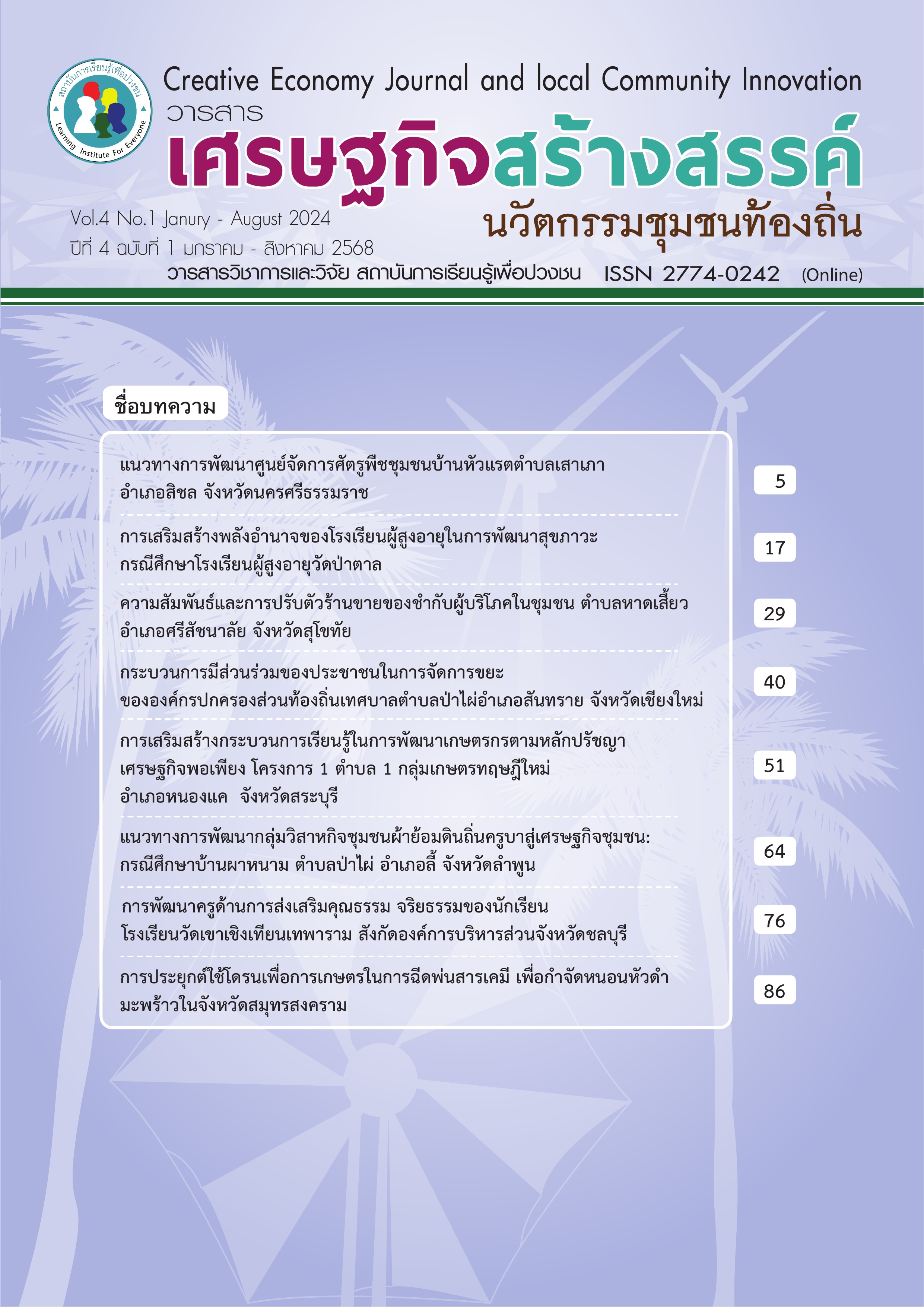
The Application of Agricultural Drones for Chemical Spraying to Eradicate Opisina arenosella in Samut Songkhram Province
Abstract
This research aimed to: 1) investigate the outbreak of the coconut black-headed caterpillar (Opisina arenosella); 2) compare the effectiveness of chemical spraying using agricultural drones; and 3) propose guidelines for the effective use of drones. Action research combined with field experiments was conducted in three coconut plantations located in Bang Nang Li and Tha Kha subdistricts, Samut Songkhram Province. Two insecticides, Lufenuron and Flubendiamide, were tested using an EA-J100 drone operated at a spraying height of 2 meters for 8 seconds per tree. Physical assessments were conducted before spraying and at 15, 30, and 60 days after spraying. Data were collected through observation, while spray distribution was examined using Water Sensitive Paper. The data were analyzed using narrative and prescriptive analyses.
The results revealed that: 1) the coconut black-headed caterpillar infestation ranged from moderate to severe. Coconut leaves were damaged and turned brown, while some trees exhibited dead crowns and eventually died. The severity of the damage tended to increase with the height and age of the coconut trees. 2) Agricultural drones were effective in applying insecticides to control the coconut black-headed caterpillar, reducing the pest survival rate to below 10% within 60 days. The treated coconut trees recovered, produced new shoots and dark green leaves, and resumed fruit production, with a clear increase in yield weight. Drone spraying also helped control spray drift, while the chemical odor gradually decreased and was no longer detected after 60 days. 3) The most suitable configuration was a multi-rotor drone with six or eight rotors, a tank capacity of 15–20 liters, a high-precision navigation system such as GPS RTK or an automatic flight-path system, and obstacle-detection functionality. The recommended application method was a fine-mist spraying technique.
It is recommended that the research findings be used to strengthen the capacity of local Drone Service Providers and develop sustainable drone-service businesses. Emphasis should be placed on using drones to rehabilitate coconut plantations and ensuring the appropriate management of chemicals in accordance with precision-agriculture principles.
References
Daoden, K., Sornnen, T., Pankasemsuk, T., Phaphuangwittayakal, P., Sringam, S., & Nicrotha, S. (2021). Development of agricultural spraying drone prototype for coconut beetle weevil control. Natural Volatiles & Essential Oils, 8(5), 8322–8322. [In Thai]
Kunde, P., Sangprachathanarak, K., Wongpichat, S., Wongphati, M., Ungsatitthanaworn, K., Pilawut, S., Phupapud, A., Phanudouangnetr, L., & Nothaisong, J. (2021). A study on time and obstacles for foliar fertilizer spraying in sugarcane fields using drones, tractors, and human labor. Khon Kaen Agriculture Journal, 50(4), 1083–1096. [In Thai]
Meesaragandla, S., Jagtap, M. P., Khatri, N., Madan, H., & Vadduri, A. A. (2024). Herbicide spraying and weed identification using drone technology in modern farms: A comprehensive review. Results in Engineering, 21, Article 101870.
Pandiselvam, R., Daliyamol, S. I., Hegde, V., Sujithra, M., Prathibha, P. S., Prathibha, V. H., & Hebbar, K. B. (2024). Evaluation of unmanned aerial vehicle for effective spraying application in coconut plantations. Heliyon, 10(19), Article e38569.
Rejeb, A., Abdollahi, A., Rejeb, K., & Treiblmaier, H. (2022). Drones in agriculture: A review and bibliometric analysis. Computers and Electronics in Agriculture, 198, Article 107017.
Saha-ya, S. (2013). Control of coconut black-headed caterpillar, Opisina arenosella (Walker), by foliar spraying. In Annual research report 2013 (pp. 385–395). Plant Protection Research and Development Office, Department of Agriculture. https://info.doa.go.th/research/frontend/download.php?id=542 [In Thai]
Saini, N., Singh, H., & Gouda, M. N. R. (2024). Use of drones in precision pest management. International Journal of Research in Agronomy, SP-7(8), 854–858.
Soontareerat, K., & Treewannakul, P. (2019). Decision-making on using Bracon hebetor natural enemies for prevention and elimination of Opisina arenosella Walker among aromatic coconut farmers in Ban Phaeo District, Samut Sakhon Province. Agricultural Science Journal, 50(1), 51–63. [In Thai]
Suasa-ard, W., & Chomphkhiao, N. (2011). Coconut black-headed caterpillar and its biological control. Kasetsart Journal Newsletter, 56(3), 52–57. [In Thai]
Downloads
Published
How to Cite
Issue
Section
License
Copyright (c) 2026 Creative Economy Journal and Community Innovation

This work is licensed under a Creative Commons Attribution-NonCommercial-NoDerivatives 4.0 International License.
Articles in this journal are copyrighted by the x may be read and used for academic purposes, such as teaching, research, or citation, with proper credit given to the author and the journal.use or modification of the articles is prohibited without permission.
statements expressed in the articles are solely the opinions of the authors.
authors are fully responsible for the content and accuracy of their articles.
other reuse or republication requires permission from the journal."


