Contemporary jewelry design from ceramic scrap with Kintsugi technique concept by Gingkalah bird dance costume
Article Sidebar
Main Article Content
Abstract
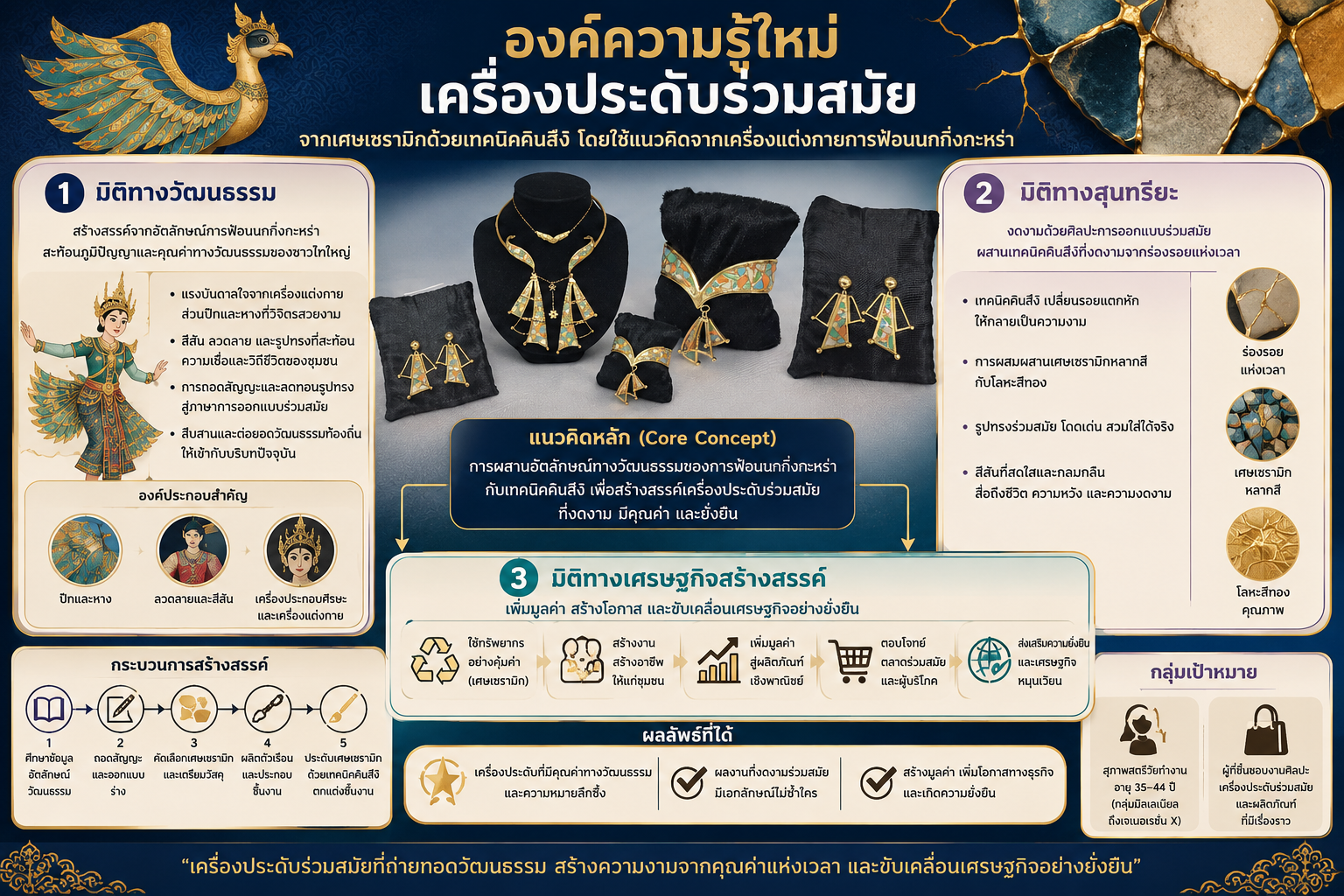
The objectives of this research were to 1) study the identity of the costume of the Kintsugi Technique and the Kintsugi Technique as a concept for jewelry creation, 2) design and manufacture contemporary jewelry from ceramic fragments using the Kintsugi Technique, and 3) evaluate the quality of contemporary jewelry from ceramic fragments using the Kintsugi Technique. The research uses an integrated research methodology. By integrating qualitative and quantitative research. The sample consisted of 70 female consumers aged 35–44 years, ceramic entrepreneurs, people with knowledge of the kinkkara and jewelry design and manufacturing experts. mean and standard deviation. The results show that the key identity of the carrot costume is pronounced in the elements of the body, wings, and tail, especially the wings and tail, which reflect the shapes, colors, rhythm of movement, and craftsmanship. Meanwhile, The Kintsugi technique can elevate the depleted ceramic fragments from its original use to new value. Both in terms of beauty, meaning, and sustainability. The result of the design and production was 1 set of jewelry prototypes, including necklaces, earrings, and bracelets. The results of the quality assessment by experts showed that the overall quality was at a high level. It has an average value of 4.46 and a standard deviation of 0.24, reflecting that such jewelry is able to integrate cultural values. Contemporary design and sustainable development concepts are significant.
Article Details

This work is licensed under a Creative Commons Attribution-NonCommercial-NoDerivatives 4.0 International License.
Articles in this journal are copyrighted by the x may be read and used for academic purposes, such as teaching, research, or citation, with proper credit given to the author and the journal.use or modification of the articles is prohibited without permission.
statements expressed in the articles are solely the opinions of the authors.
authors are fully responsible for the content and accuracy of their articles.
other reuse or republication requires permission from the journal."
References
คินสึงิ ศิลปะความงามในความไม่สมบูรณ์ของญี่ปุ่น. 2564. (ออนไลน์) https://wexpats.com/th/guide/as/jp/detail/8659. (วันที่สืบค้น 15 ตุลาคม 2566).
ฝนทิพย์ วรรธนะศิรินทร์ รังสิตสวัสดิ์. 2564. การพัฒนาเศษวัสดุเซรามิกอย่างสร้างสรรค์ เพื่อการออกแบบ ผลิตภัณฑ์ Upcycling ด้วยแนวคิดการออกแบบเพื่อสิ่งแวดล้อม. รายงานการวิจัย. มหาวิทยาลัย บูรพา.
ภัควิภา เงินคีรี. 2559. ฟ้อนนกกิงกะหร่า ศิลปะการแสดงไทใหญ่ ของพ่อครูปายเมือง ลายใส. เชียงใหม่: ภาควิชาศิลปะไทย คณะวิจิตรศิลป์ มหาวิทยาลัยเชียงใหม่. (วันที่สืบค้น 10 ตุลาคม 2566).
ศูนย์ส่งเสริมศิลปาชีพระหว่างประเทศ (องค์การมหาชน). 2562. ประดิษฐ์นกกิ่งกะหร่า. (ออนไลน์).
https://www.sacit.or.th/uploads/items/attachments/614416c557d290c3e81571330d
acc6/_28f9562a5816345247ababa3708b9d73.pdf. (วันที่สืบค้น 10 ตุลาคม 2566).
สำนักหอสมุดมหาวิทยาลัยเชียงใหม่. 2555. อุตสาหกรรมเซรามิกของโลกและในประเทศไทย.
(ออนไลน์). https://archive.lib.cmu.ac.th/full/T/2555/econ30955wp_ch3.pdf.
(วันที่สืบค้น 15 ตุลาคม 2566).
