Contemporary Jewelry Design in Preppy Style Combined with Streetwear Using Enamel Techniques Inspired by Wiang Kalong Ceramic Patterns in Hua Fai Sub-district Wiang Pa Pao District, Chiang Rai Province
Article Sidebar
Main Article Content
Abstract
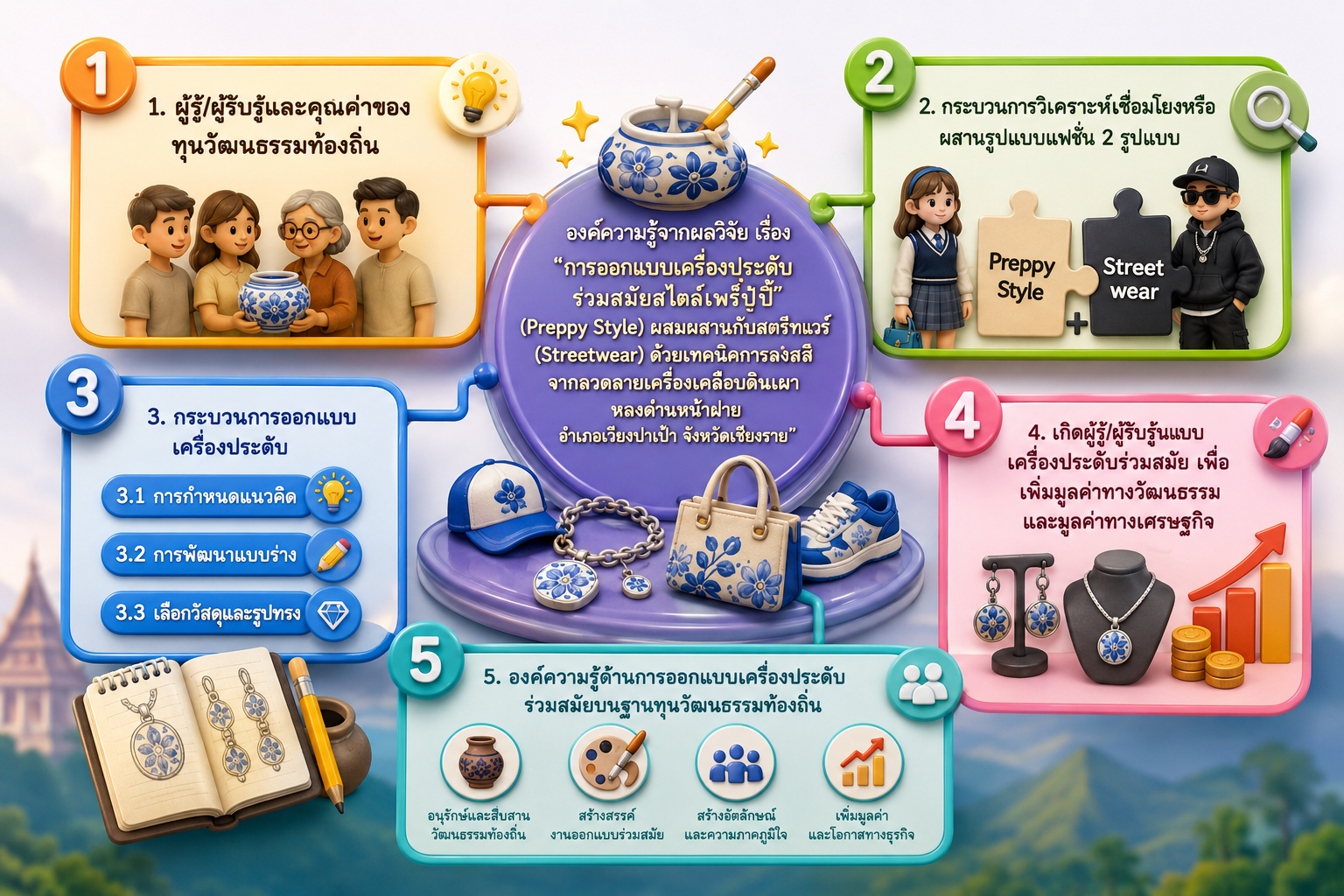
The objectives of this research were to 1) study the identity of the costume of the Kintsugi Technique and the Kintsugi Technique as a concept for jewelry creation, 2) design and manufacture contemporary jewelry from ceramic fragments using the Kintsugi Technique, and 3) evaluate the quality of contemporary jewelry from ceramic fragments using the Kintsugi Technique. The research uses an integrated research methodology. By integrating qualitative and quantitative research. The sample consisted of 70 female consumers aged 35–44 years, ceramic entrepreneurs, people with knowledge of the kinkkara and jewelry design and manufacturing experts. mean and standard deviation. The results show that the key identity of the carrot costume is pronounced in the elements of the body, wings, and tail, especially the wings and tail, which reflect the shapes, colors, rhythm of movement, and craftsmanship. Meanwhile, The Kintsugi technique can elevate the depleted ceramic fragments from its original use to new value. Both in terms of beauty, meaning, and sustainability. The result of the design and production was 1 set of jewelry prototypes, including necklaces, earrings, and bracelets. The results of the quality assessment by experts showed that the overall quality was at a high level. It has an average value of 4.46 and a standard deviation of 0.24, reflecting that such jewelry is able to integrate cultural values. Contemporary design and sustainable development concepts are significant.
Article Details

This work is licensed under a Creative Commons Attribution-NonCommercial-NoDerivatives 4.0 International License.
Articles in this journal are copyrighted by the x may be read and used for academic purposes, such as teaching, research, or citation, with proper credit given to the author and the journal.use or modification of the articles is prohibited without permission.
statements expressed in the articles are solely the opinions of the authors.
authors are fully responsible for the content and accuracy of their articles.
other reuse or republication requires permission from the journal."
References
ชไมพร สุศรวัสวงศ์ และ อรรถพนธ์ พงษ์เลาหพันธุ์. (2563). การออกแบบเครื่องแต่งกายสตรีทแวร์สำหรับ
กลุ่มนิยมความหลากหลายทางวัฒนธรรมจากแนวคิดศิลปะลัทธินีโอ-ดาดา. วารสารดีไซน์เอคโค,
(1), 46–55.
บุญชม ศรีสะอาด. (2553). การวิจัยเบื้องต้น (พิมพ์ครั้งที่ 8). กรุงเทพฯ: สุวีริยสาส์น.
ประภัสสร ภู่ประเสริฐ. (2567). นวัตกรรมการลงยาสีเย็นบนลวดลายจิตรกรรมไทยประยุกต์สู่การสร้าง
อาชีพ. วารสารพุทธศิลปกรรม, 7(2), 1–23.
พิพิธภัณฑสถานแห่งชาติเชียงแสน. (2569). เครื่องถ้วยเวียงกาหลง. สืบค้นเมื่อ 10 เมษายน 2569, จาก
https://www.finearts.go.th/promotion/view/14240
ภาณุพงศ์ จงชาน และ ไพโรจน์ วรพจน์พรชัย. (2564). กะลา ดู ดี: การสร้างสรรค์งานหัตถกรรม
เครื่องประดับจากกะลามะพร้าว. วารสารศิลปกรรมบูรพา, 24(1), 11–24.
ฤดีชนก รุ่งเรืองไมตรี และ วริศรา กลมทุกสิ่ง. (2568). ความตระหนักรู้ถึงแบรนด์ ความน่าเชื่อถือ และความ
โดดเด่นที่ส่งผลต่อความตั้งใจในการซื้อเครื่องประดับแบรนด์หรูของไทยของผู้บริโภค Generation
MZ. วารสารวิชาการวิทยาลัยสันตพล, 11(2), 127–128.
วรุต วัฒนากิจขจร และคณะ. (2564). การออกแบบผลิตภัณฑ์เครื่องประดับจากทองเหลือง. วารสารศิลปะ
ศาสตร์ มทร.กรุงเทพ, 3(2), 13–24.
วิมล ศิลปะกิจ, พระครู. (2562). งานศิลป์พิมพ์ลายเวียงกาหลงบนวัสดุที่หลากหลาย: นวัตกรรมศิลปะเวียง
กาหลง. รายงานการวิจัย. มหาวิทยาลัยมหาจุฬาลงกรณราชวิทยาลัย
