
"Design and Development of Outdoor Seating for a Co-working Space at Rajamangala University of Technology Lanna, Jed Yod Campus,"
Article Sidebar
Main Article Content
Abstract
This research aimed to: (1) investigate the behaviors and needs of students, lecturers, and staff members in the Faculty of Fine Arts and Architecture; (2) design and develop outdoor seating furniture for a co-working space at Rajamangala University of Technology Lanna, Jet Yod Campus; and (3) promote social interaction and learning well-being among users. The study employed both qualitative and quantitative research methods. The population consisted of students, lecturers, and staff members within the Faculty of Fine Arts and Architecture. The sample was selected through purposive sampling and included 70 students, 20 lecturers, and 10 staff members, totaling 100 participants. Data collection instruments included interviews, observation forms, and participatory observation. The collected data were analyzed using content analysis.
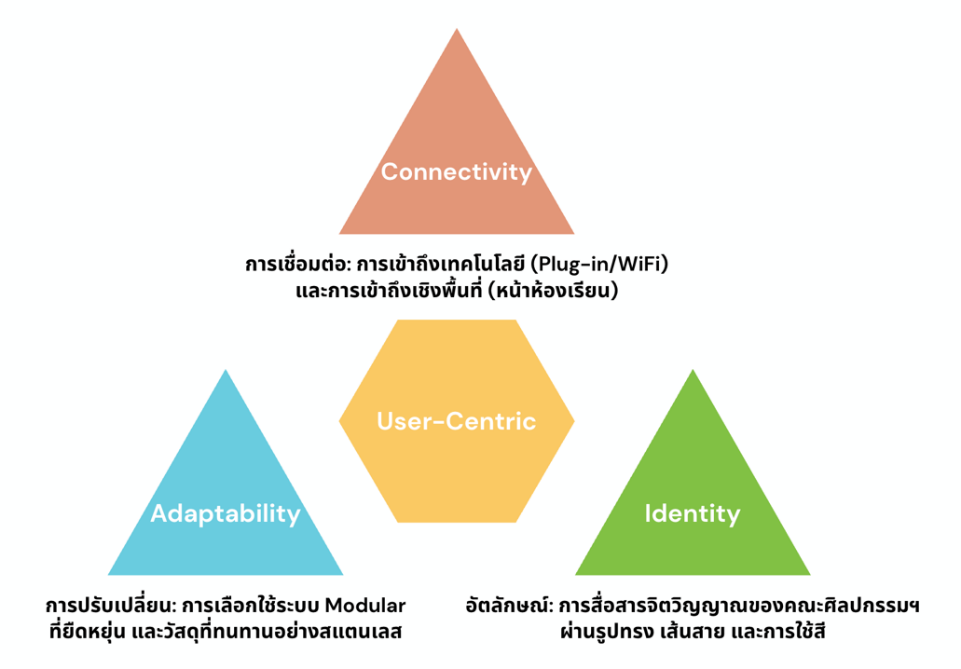
The research findings revealed that: (1) students, lecturers, and staff members primarily utilized the area in front of classrooms, which significantly influenced their seating preferences. Key factors affecting the selection of seating furniture included the location in front of classrooms, the form and color of the furniture that reflected the identity of the faculty, and its suitability for relaxation and temporary work activities. (2) The design and development of outdoor seating furniture for the co-working space emphasized functional features, such as electrical outlets, supportive facilities, and sun-shading umbrellas. The furniture was designed using a modular concept that allows flexible configurations to accommodate relaxation and modern working activities. (3) The promotion of social interaction and learning well-being was achieved through seating arrangements that enabled users to face one another, similar to a meeting setting, thereby encouraging communication, collaborative learning, and interpersonal interaction among members of the faculty.
Article Details

This work is licensed under a Creative Commons Attribution-NonCommercial-NoDerivatives 4.0 International License.
Articles in this journal are copyrighted by the x may be read and used for academic purposes, such as teaching, research, or citation, with proper credit given to the author and the journal.use or modification of the articles is prohibited without permission.
statements expressed in the articles are solely the opinions of the authors.
authors are fully responsible for the content and accuracy of their articles.
other reuse or republication requires permission from the journal."
References
จิตฎาณพัชญ์ ตันติเศรณี. (2567). การใช้บริการสิ่งสนับสนุนการเรียนรู้ : กรณีศึกษาความต้องการของนักศึกษาคณะ
วิศวกรรมศาสตร์ มหาวิทยาลัยเทคโนโลยีราชมงคลอีสาน วิทยาเขตขอนแก่น. วารสารวิศวกรรมศาสตร์และ
การวิจัยเชิงนวัตกรรม, 2 (2), 7-13.
สุปิยา ปัญญาทอง และ พิทักษ์ พงศ์แบ่งทิศ. (268). “Co-Working Space เพื่อการเรียนรู้ยุคดิจิทัล: แนวทาง
การออกแบบที่ตอบสนองต่อพฤติกรรมนักศึกษา Gen Z, Gen Alpha และ Gen. วารสารวิชาการ
บัณฑิตศึกษา, 3(2), 85-98.
วลิดา อุ่นเรือน และอังคณา อ่อนธานี .(2566). การพัฒนารูปแบบการจัดการเรียนรู้ตามแนวทฤษฎีการสร้างความรู้ด้วย
การปฏิสัมพันธ์ทางสังคมร่วมกับแนวคิดการ เรียนรู้ตามสภาพจริงเพื่อส่งเสริมความสามารถในการจัดการ
เรียนรู้ ที่เน้นความแตกต่างระหว่างบุคคลสำหรับนักศึกษา ครู. Journal of Education and Innovation,
(1), 222-237.
Ricarda B.,& Andreas J.(2018). Coworking-spaces: how a phenomenon of the sharing economy builds a novel trend for the workplace and for entrepreneurship.Review of Managerile Science.(1),Springer-Verlag.317-334.
Spinuzzi, C. (2012). Working alone together: Coworking as a community of practice. Journal of Business and Technical Communication, 26(4), 399–441.
Fuzi, A. (2015). Co-working spaces for promoting entrepreneurship and innovation. Competitiveness Review, 25(5), 572–590.
