
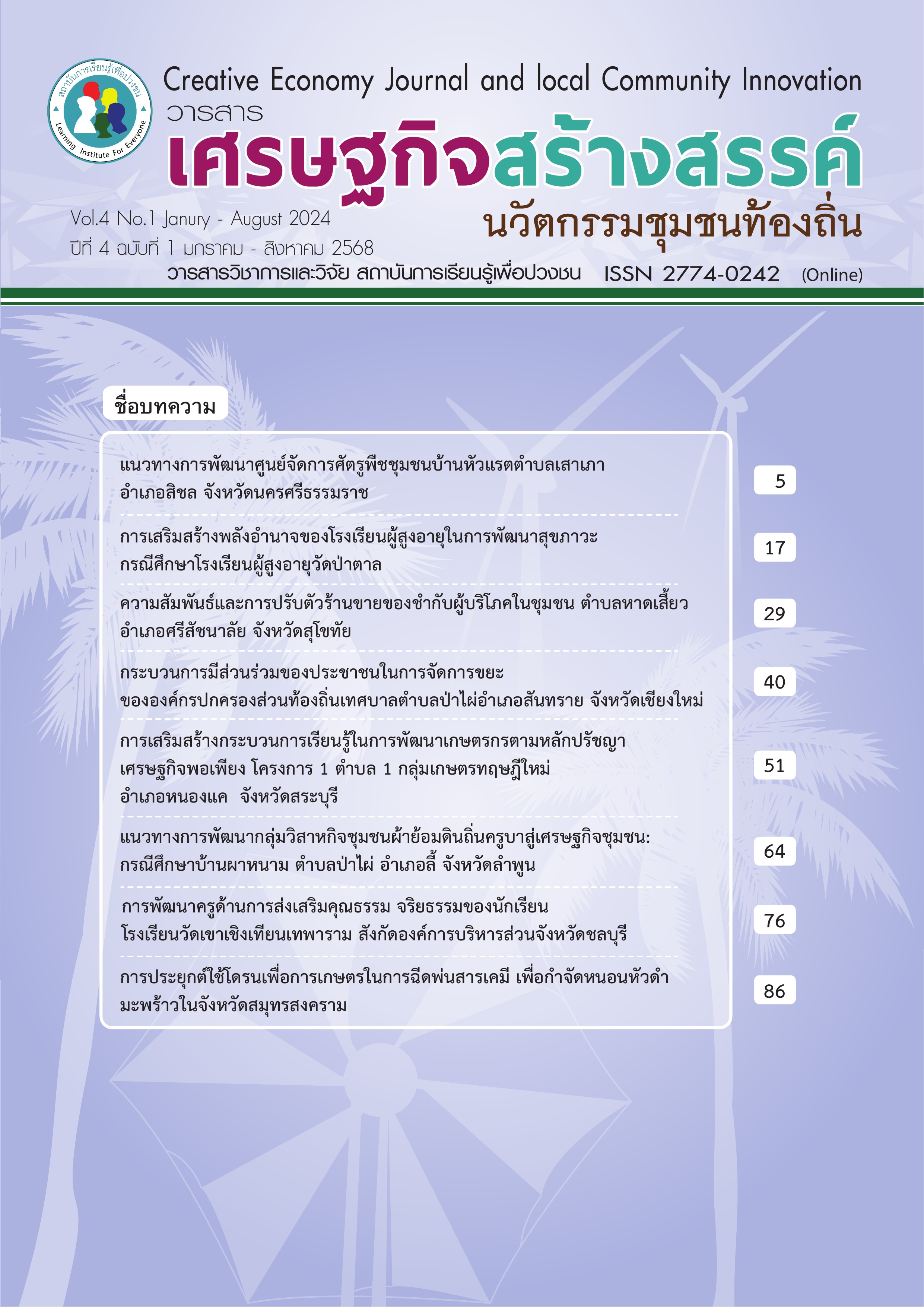
Teacher Development in Promoting Student Morality and Ethics, Wat Khao Chaeng Thian Theparam School, Chonburi Provincial Administrative Organization
Abstract
This research aimed to: 1) study the current conditions and problems concerning the promotion of morality and ethics among students at Wat Khao Chaeng Thian Theparam School under the Chonburi Provincial Administrative Organization; and 2) propose guidelines for developing teachers’ ability to promote morality and ethics among students. This action research employed the PAOR process—Plan, Act, Observe, and Reflect—based on the concepts of Kemmis and McTaggart. The key informants comprised 65 participants: 38 teachers, 12 student committee members, and 15 school board members. The research instruments included observation forms, interview guidelines, focus-group discussion guidelines, and researcher-developed evaluation forms. The data were analyzed using the mean, standard deviation, and descriptive analysis.
The research findings revealed that: 1) most teachers recognized the importance of instilling morality and ethics in students but lacked a systematic and continuous approach; 2) the school organized morality-promoting activities, such as chanting, merit-making on important occasions, and campaigns encouraging good behavior, but these activities had not been sufficiently integrated into classroom instruction; 3) most students demonstrated fundamental moral qualities, including discipline and gratitude, although some lacked responsibility and public-mindedness; and 4) school administrators had established policies to promote morality and ethics but lacked a concrete monitoring and evaluation system.
The principal problems were that teachers lacked the knowledge and skills required to integrate morality and ethics into lesson plans; internal supervision and knowledge exchange among teachers were insufficient; some students exhibited inappropriate behavior, such as using impolite language, arriving late, and lacking volunteer spirit; and parental and community participation in cultivating students’ morality remained limited.
Following the teacher-development process, teachers were able to design and implement lesson plans that meaningfully integrated morality and ethics into learning activities. Creative activities—including “Morality Classroom,” “Friends Helping Friends,” and “Good Students with Volunteer Spirit”—were organized. Students’ moral behavior continuously improved, particularly in discipline, honesty, gratitude, and public-mindedness. Furthermore, the school developed an environment conducive to becoming a “Moral School” and gained recognition from the community.
References
กนกพร เพ็ชรพงศ์ และคณะ. (2558). บทบาทของครูในการส่งเสริมความมีวินัยในตนเองของนักเรียนในสถานศึกษาขั้นพื้นฐาน. สำนักงานเขตพื้นที่การศึกษาพิจิตร เขต 1.
กรมการศาสนา. (2562). แนวทางการส่งเสริมคุณธรรม จริยธรรมในสถานศึกษา. กระทรวงวัฒนธรรม.
กระทรวงศึกษาธิการ. (2550). หลักการจัดการศึกษาเพื่อพัฒนาคุณธรรม จริยธรรม. กระทรวงศึกษาธิการ.
กระทรวงศึกษาธิการ. (2551). หลักสูตรแกนกลางการศึกษาขั้นพื้นฐาน พุทธศักราช 2551. โรงพิมพ์ชุมนุมสหกรณ์การเกษตรแห่งประเทศไทย.
เกษม วัฒนชัย และคณะ. (2560). คุณธรรม จริยธรรม และค่านิยมในสังคมไทย. สำนักงานคณะกรรมการการศึกษาขั้นพื้นฐาน.
ชัยณรงค์ ศรีสุข. (2553). จริยธรรมและจรรยาบรรณในวิชาชีพครู. มหาวิทยาลัยศรีนครินทรวิโรฒ.
ชนาภรณ์ เพาพาน. (2555). วินัยและการพัฒนานักเรียนไทย. สำนักพิมพ์ไทยวัฒนาพานิช.
ช่อชบา นาคบุญ. (2560). การพัฒนาคุณธรรมจริยธรรมของนักเรียนในโรงเรียนสังกัดสำนักงานคณะกรรมการการศึกษาขั้นพื้นฐาน [วิทยานิพนธ์ครุศาสตรมหาบัณฑิต, มหาวิทยาลัยราชภัฏพระนครศรีอยุธยา].
พรรณอร อุชุภาพ. (2561). การพัฒนาจริยธรรมในสถานศึกษา. มหาวิทยาลัยเกษตรศาสตร์.
Downloads
Published
How to Cite
Issue
Section
License

This work is licensed under a Creative Commons Attribution-NonCommercial-NoDerivatives 4.0 International License.
Articles in this journal are copyrighted by the x may be read and used for academic purposes, such as teaching, research, or citation, with proper credit given to the author and the journal.use or modification of the articles is prohibited without permission.
statements expressed in the articles are solely the opinions of the authors.
authors are fully responsible for the content and accuracy of their articles.
other reuse or republication requires permission from the journal."


