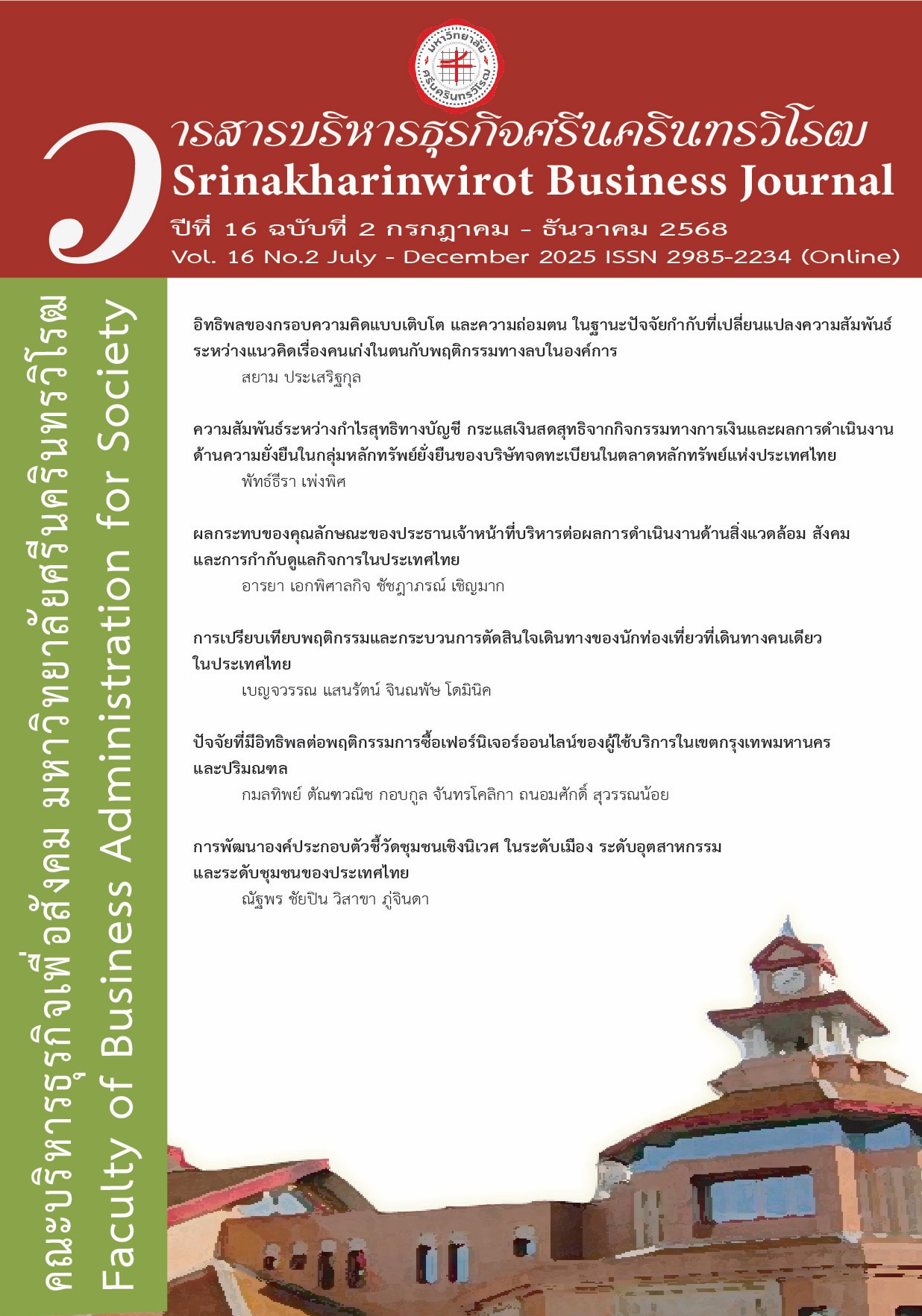
อิทธิพลของกรอบความคิดแบบเติบโต และความถ่อมตน ในฐานะปัจจัยกำกับที่เปลี่ยนแปลงความสัมพันธ์ระหว่างแนวคิดเรื่องคนเก่งในตนกับพฤติกรรมทางลบในองค์การ
คำสำคัญ:
คนเก่งในตนเอง , พฤติกรรมทางลบในองค์การ , กรอบความคิดแบบเติบโต , ความถ่อมตนในตนเองบทคัดย่อ
การวิจัยครั้งนี้มีวัตถุประสงค์เพื่อศึกษาความสัมพันธ์ระหว่างแนวคิดเรื่องคนเก่งในตนเองกับพฤติกรรมทางลบในองค์การ โดยมีกรอบความคิดแบบเติบโตและความถ่อมตนในตนเองเป็นตัวแปรกำกับความสัมพันธ์ดังกล่าว กลุ่มตัวอย่างคือพนักงานประจำจำนวน 300 คน จากหลากหลายอุตสาหกรรมในประเทศไทย ซึ่งมีประสบการณ์ทำงานอย่างน้อย 1 ปี เครื่องมือที่ใช้เป็นแบบสอบถามมาตราส่วนประมาณค่า 5 ระดับ และทำการวิเคราะห์ข้อมูลด้วยสถิติเชิงพรรณนา สหสัมพันธ์ และการวิเคราะห์ถดถอยพหุคูณแบบมีตัวแปรกำกับ (Moderated multiple regression)
ผลการวิจัยพบว่า แนวคิดเรื่องคนเก่งในตนเองมีความสัมพันธ์เชิงบวกกับพฤติกรรมทางลบในองค์การอย่างมีนัยสำคัญทางสถิติ ขณะเดียวกันกรอบความคิดแบบเติบโตและความถ่อมตนในตนเองสามารถลดความแรงของความสัมพันธ์ดังกล่าวได้อย่างมีนัยสำคัญ กล่าวคือ บุคคลที่มีแนวโน้มมองว่าตนเองเป็นคนเก่งแต่มีความคิดแบบเติบโตหรือมีความถ่อมตน จะมีแนวโน้มแสดงพฤติกรรมทางลบน้อยกว่าผู้ที่ขาดคุณลักษณะเหล่านี้
ผลการวิจัยชี้ให้เห็นถึงความสำคัญของการส่งเสริมกรอบความคิดแบบเติบโตและความถ่อมตนในองค์การเพื่อป้องกันพฤติกรรมทางลบ โดยเฉพาะในกลุ่มพนักงานที่มีความเชื่อมั่นในตนเองสูง
เอกสารอ้างอิง
Bahmannia, S. (2023). Even nectar is poisonous in excess: The impact of leader humility on pride,
entitlement, and organizational citizenship behavior. Journal of Leadership & Organizational Studies, 30(4), 381–396. https://doi.org/10.1177/15480518231204675
Bandura, A. (1986). Social foundations of thought and action: A social cognitive theory. Englewood Cliffs, NJ:
Prentice-Hall. https://api.semanticscholar.org/CorpusID:142519016
Burnette, J. L., O'Boyle, E. H., VanEpps, E. M., Pollack, J. M., & Finkel, E. J. (2013). Mind-sets matter: A meta-analytic review of implicit theories and self-regulation. Psychological Bulletin, 139(3), 655-701. https://faculty.wcas.northwestern.edu/eli-finkel/documents/InPress_BurnetteOBoyleVanEpps
PollackFinkel_PsychBull_000.pdf
Chamorro-Premuzic, T. (2013). Confidence: Overcoming low self-esteem, insecurity, and self-doubt. Penguin.
https://anyflip.com/zmunv/qrqi
Chamorro-Premuzic, T. (2014). Confidence: The surprising truth about how much you need and how to get it. Hudson Street Press. https://www.perlego.com/book/3707898/confidence-the-surprising-truth-about-
how-much-you-need-and-how-to-get-it-pdf
Chen, X., Harari, O., & Fine, S. (2022). High level talents’ perceived overqualification and withdrawal behavior: A power perspective based on survival needs. Frontiers in Psychology, 13, Article 921627. https://www.frontiersin.org/journals/psychology/articles/10.3389/fpsyg.2022.921627/full
Cohen, J. (1988). Statistical power analysis for the behavioral sciences (2nd ed.). Hillsdale, NJ: Lawrence Erlbaum Associates. https://utstat.utoronto.ca/brunner/oldclass/378f16/readings/CohenPower.pdf
Cropanzano, R., & Mitchell, M. S. (2005). Social exchange theory: An interdisciplinary review. Journal of Management, 31(6), 874–900. https://www.researchgate.net/profile/Russell_Cropanzano/publication/2
_Social_Exchange_Theory_An_Interdisciplinary_Review/links/00463533b6c7daca39000000
Duval, S., & Wicklund, R. A. (1972). A theory of objective self awareness. Academic Press. https://archive.org/
details/theoryofobjectiv0000duva/page/n255/mode/2up
Dweck, C. S. (2006). Mindset: The new psychology of success. Random House. https://adrvantage.com/wp-
content/uploads/2023/02/Mindset-The-New-Psychology-of-Success-Dweck.pdf
Ferris, G. R., Treadway, D. C., Perrewé, P. L., Brouer, R. L., Douglas, C., & Lux, S. (2007). Political skill in
organizations. Journal of Management, 33(3), 290–320. https://www.crforum.co.uk/wp-content/uploads/2017/06/Political-Skill-in-Organizations.pdf
Gino, F., & Pierce, L. (2010). Lying to level the playing field: Why people may dishonestly help or hurt others to create equity. Journal of Business Ethics, 95(1), 89–103. https://static1.squarespace.com/static/55d
cde36e4b0df55a96ab220/t/55e75e6de4b0cbb3aeddf7b0/1441226349200/gino+pierce+JBE+2010.pdf
Hadmar, A. S., Hendryadi, S., Suratna, S., & Karyatun, S. (2022). Leader humility, sense of power, and
interpersonal deviance. Journal of Organizational Behavior. Advance online publication. https://doi.org/10.1002/job.2674
Hair, J. F., Black, W. C., Babin, B. J., & Anderson, R. E. (2010). Multivariate data analysis (7th ed.). Pearson Prentice Hall. https://www.drnishikantjha.com/papersCollection/Multivariate%20Data%20Analysis.pdf
Hobfoll, S. E. (1989). Conservation of resources: A new attempt at conceptualizing stress. American Psychologist, 44(3), 513–524. https://www.researchgate.net/profile/Stevan_Hobfoll/publication/20507
_Conservation_of_Resources_A_New_Attempt_at_Conceptualizing_Stress/links/53ed1c190cf2981ada12af0c.pdf
Jiang, D., Ning, L & Zhang Y (2024). Perceived overqualification as a double-edged sword for employee
creativity: The mediating role of job crafting and work withdrawal behavior. PLOS ONE, 19(1), e0304529. https://doi.org/10.1371/journal.pone.0304529.
Keating, L. A., & Heslin, P. A. (2015). The potential role of mindsets in unleashing employee engagement. Human Resource Management Review, 25(4), 329–341. https://unsworks.unsw.edu.au/entities/
publication/9d788cc4-2915-4a91-bf10-3b2c58032f45.
Liu, J., & Tong, Y. (2022). Employee growth mindset and innovative behavior: The roles of employee strengths use and strengths-based leadership. Frontiers in Psychology, 13, 888002. https://www.
frontiersin.org/journals/psychology/articles/10.3389/fpsyg.2022.814154/full
Lu, L., Luo, T., & Zhang, Y. (2023). Perceived overqualification and deviant innovation behavior: The roles of creative self-efficacy and perceived organizational support. Frontiers in Psychology, 14, 967052.
https://www.frontiersin.org/journals/psychology/articles/10.3389/fpsyg.2023.967052/full
Nielsen, R., Marrone, J. A., & Slay, H. S. (2010). A new look at humility: Exploring the humility concept and its role in socialized charismatic leadership. Journal of Leadership & Organizational Studies, 17(1),
–43. https://www.researchgate.net/publication/247784719_A_New_Look_at_Humility_Exploring_
the_Humility_Concept_and_Its_Role_in_Socialized_Charismatic_Leadership.
Nunnally, J. C., & Bernstein, I. H. (1994). Psychometric theory (3rd ed.). McGraw-Hill. https://vdoc.pub/
documents/psychometric-theory-34g327sgcjc0
Owens, B. P., Johnson, M. D., & Mitchell, T. R. (2013). Expressed humility in organizations: Implications for performance, teams, and leadership. Organization Science, 24(5), 1517–1538. https://faculty.
washington.edu/mdj3/Humility%20and%20performance.pdf
Pletzer, J. L., Bentvelzen, M., Oostrom, J. K., & de Vries, R. E. (2019). A meta-analysis of the relations
between personality and workplace deviance: Big Five versus HEXACO. Journal of Vocational Behavior, 112, 369–383.https://www.researchgate.net/publication/332257205_A_meta-analysis_of_
the_relations_between_personality_and_workplace_deviance_Big_Five_versus_HEXACO
Robinson, S. L., & Bennett, R. J. (1995). A typology of deviant workplace behaviors: A multidimensional scaling study. Academy of Management Journal, 38(2), 555–572. https://www.researchgate.net/
publication/228079661_A_Typology_of_Deviant_Workplace_Behaviors_A_Multidimensional_Scaling_Study.
Rogers, B. A., Siegel Christian, J., Jennings, R. E., & Lanaj, K. (2023). The growth mindset at work: Will
employees help others to develop themselves? Academy of Management Discoveries, 9(1), 67–92. https://www.researchgate.net/publication/362353147_The_Growth_Mindset_at_Work_Will_Employees_Help_Others_to_Develop_Themselves
Sedikides, C., & Gregg, A. P. (2008). Self-enhancement: Food for thought. Perspectives on Psychological Science, 3(2), 102–116. https://www.researchgate.net/publication/263723262_Self-Enhancement_
Food_for_Thought
Swann, W. B. (1983). Self-verification: Bringing social reality into harmony with the self. Psychological Perspectives on the Self, 2, 33–66. https://labs.la.utexas.edu/swann/files/2022/03/swann-83-bringing
SocReal.pdf
Trinh, M. P. (2019). Overcoming the shadow of expertise: How humility and learning goal orientation help
knowledge leaders become more flexible. Frontiers in Psychology, 10, article 2505. https://www.frontiersin.org/journals/psychology/articles/10.3389/fpsyg.2019.02505/full
Van Zelderen, A., Dries, N., & Marescaux, E. (2023). Talents under threat: The anticipation of being
ostracized by non-talents drives talent turnover. Group & Organization Management. https://journals.sagepub.com/doi/10.1177/10596011231211639
Vera, D., & Rodriguez-Lopez, A. (2004). Strategic virtues: Humility as a source of competitive advantage.
Organizational Dynamics, 33(4), 393–408. https://doi.org/10.1016/j.orgdyn.2004.09.006
Weiss, H. M., & Cropanzano, R. (1996). Affective events theory: A theoretical discussion of the structure causes and consequences of affective experiences at work. Research in Organizational Behavior, 18, 1–74. https://web.mit.edu/curhan/www/docs/Articles/15341_Readings/Affect/AffectiveEvents
Theory_WeissCropanzano.pdf
Yeager, D. S., & Dweck, C. S. (2012). Mindsets that promote resilience: When students believe that personal characteristics can be developed. Educational Psychologist, 47(4), 302–314. https://url.in.th/RGdCm
Yu, T., He, L., Ying, H., Liu, J., Wu, Y., Wang, Y., & Pan, X. (2024). Growth Mindset and Job Crafting: A
Trait Activation Perspective with Job Autonomy as Moderator. Behavioral Sciences, 14, 1221. http://dx.doi.org/10.3390/bs14121221
ดาวน์โหลด
เผยแพร่แล้ว
รูปแบบการอ้างอิง
ฉบับ
ประเภทบทความ
สัญญาอนุญาต
ลิขสิทธิ์ (c) 2025 วารสารบริหารธุรกิจศรีนครินทรวิโรฒ

อนุญาตภายใต้เงื่อนไข Creative Commons Attribution-NonCommercial-ShareAlike 4.0 International License.
ลิขสิทธิ์ของบทความที่ได้รับการตีพิมพ์ในารสารบริหารธุรกิจศรีนครินทรวิโรฒ เป็นของวารสาร โดยผู้เขียนยินยอมโอนสิทธิ์ในการเผยแพร่และจัดพิมพ์บทความให้แก่วารสาร เมื่อบทความได้รับการตอบรับเพื่อตีพิมพ์ วารสารมีสิทธิ์ในการจัดพิมพ์ เผยแพร่ และจัดเก็บบทความในรูปแบบสิ่งพิมพ์และสื่ออิเล็กทรอนิกส์
ทางวารสารอนุญาตให้นำเนื้อหาไปใช้เพื่อประโยชน์ทางการศึกษาและการวิจัยที่ไม่แสวงหากำไรได้ โดยต้องอ้างอิงแหล่งที่มาอย่างถูกต้องครบถ้วน การนำไปใช้ ดัดแปลง เผยแพร่ซ้ำ หรือใช้ในเชิงพหาณิชย์ ต้องได้รับอนุญาตเป็นลายลักษณ์อักษรจากวารสารก่อน


