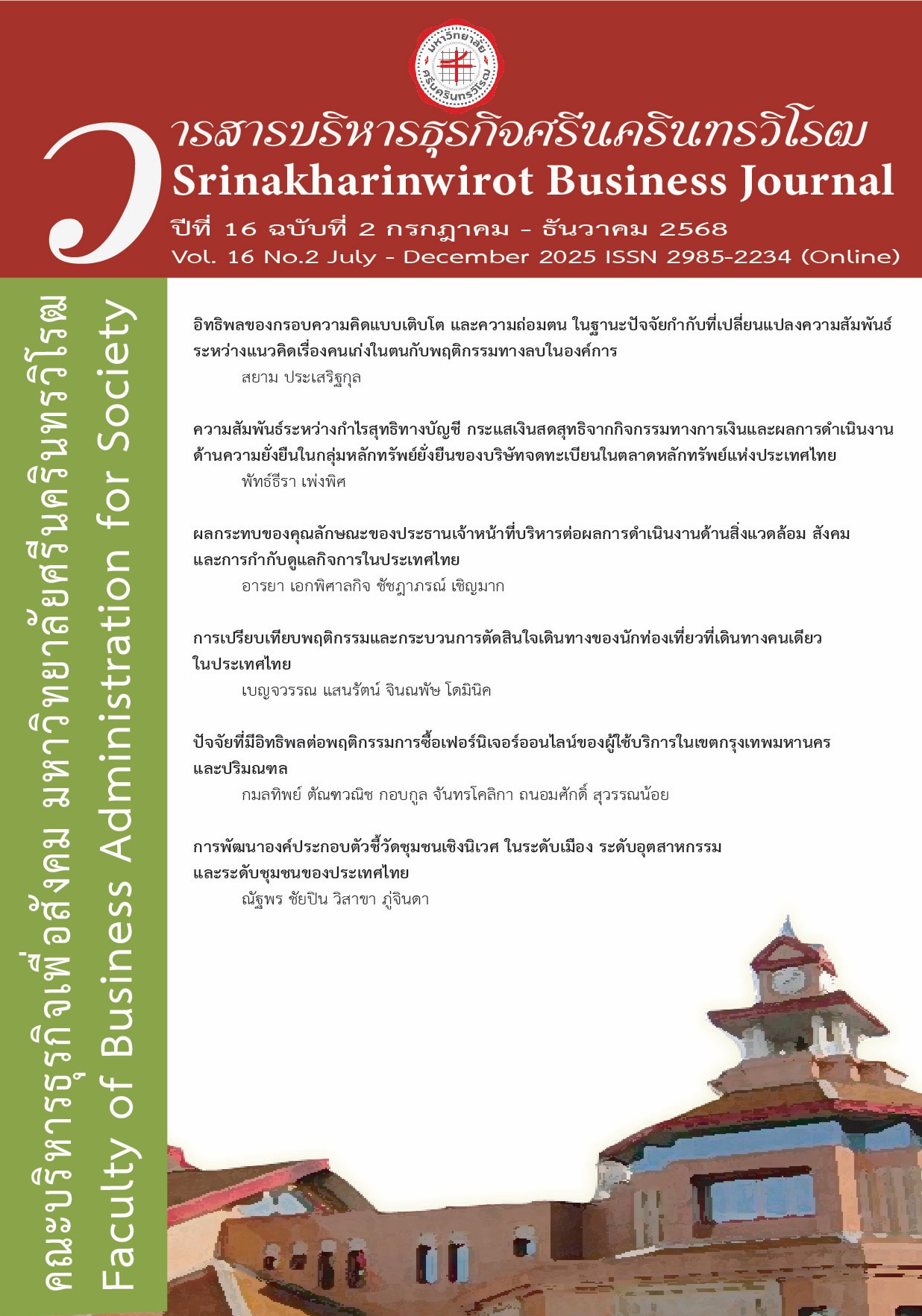
ความสัมพันธ์ระหว่างกำไรสุทธิทางบัญชี กระแสเงินสดสุทธิจากกิจกรรมทางการเงิน และผลการดำเนินงานด้านความยั่งยืนในกลุ่มหลักทรัพย์ยั่งยืนของ บริษัทจดทะเบียนในตลาดหลักทรัพย์แห่งประเทศไทย
คำสำคัญ:
กำไรสุทธิทางบัญชี, ผลการดำเนินงานด้านความยั่งยืน, การจัดอันดับ ESG , กระแสเงินสด , ตลาดหลักทรัพย์แห่งประเทศไทยบทคัดย่อ
งานวิจัยนี้วัตถุประสงค์เพื่อศึกษาความสัมพันธ์ระหว่างกำไรสุทธิทางบัญชี กระแสเงินสดจากกิจกรรมทางการเงิน และผลการดำเนินงานด้านความยั่งยืนในกลุ่มหลักทรัพย์ยั่งยืนของบริษัทจดทะเบียนในตลาดหลักทรัพย์แห่งประเทศไทย โดยการรวบรวมข้อมูลจากรายงานประจำปี แบบแสดงรายงาน 56-1 ณ สิ้นรอบบัญชีจากเว็บไซต์ของสำนักงานคณะกรรมการกำกับหลักทรัพย์และตลาดหลักทรัพย์ และ รายงานข้อมูลเกี่ยวกับการดำเนินงานด้านสิ่งแวดล้อม สังคม และการกำกับดูแลกิจการ (ESG) จากเว็บไซต์รีฟินิทิฟ สำหรับ 185 บริษัท ในปี พ.ศ. 2564 – 2566 ทั้งหมด 494 ชุดข้อมูล โดยตัวแปรอิสระที่ใช้ในการศึกษาครั้งนี้ คือ กำไรสุทธิทางบัญชี (NETPROFIT) และกระแสเงินสดสุทธิจากกิจกรรมทางการเงิน ซึ่งแบ่งออกเป็น 3 กิจกรรม ได้แก่ กระแสเงินสดสุทธิจากกิจกรรมดำเนินงาน (CFO) กระแสเงินสดสุทธิจากกิจกรรมการลงทุน (CFI) และ กระแสเงินสดสุทธิจากกิจกรรมการจัดหาเงิน (CFF) ตัวแปรตาม คือ ผลการดำเนินงานด้านความยั่งยืน (SUSTAIN) ซึ่งวัดจากการดำเนินงานด้านสิ่งแวดล้อม สังคม และ การกำกับดูแลกิจการ และมีการใช้ตัวแปรกระแสเงินสดสุทธิจากกิจกรรมทางการเงินเป็นตัวแปรเชิงกำกับ เพื่อวิเคราะห์อิทธิพลที่มีต่อความสัมพันธ์ระหว่างตัวแปรอิสระและตัวแปรตามในกลุ่มหลักทรัพย์ยั่งยืนของบริษัทจดทะเบียนในตลาดหลักทรัพย์แห่งประเทศไทย งานวิจัยนี้ใช้ข้อมูลเชิงปริมาณและเมื่อใช้สถิติพรรณนาในการอธิบายค่าสถิติเบื้องต้นของกลุ่มตัวอย่าง 494 ชุดข้อมูล พบว่ากำไรสุทธิทางบัญชีของกลุ่มหลักทรัพย์ยั่งยืนของบริษัทจดทะเบียนในตลาดหลักทรัพย์แห่งประเทศไทย มีค่าเฉลี่ยอยู่ที่ 5,135.69 ล้านบาท กระแสเงินสดสุทธิจากกิจกรรมดำเนินงาน มีค่าเฉลี่ยอยู่ที่ 7,814.81 ล้านบาท กระแสเงินสดสุทธิจากกิจกรรมการลงทุน (CFI) มีค่าเฉลี่ยอยู่ที่ -4,905.93 ล้านบาท และกระแสเงินสดสุทธิจากกิจกรรมการจัดหาเงิน (CFF) มีค่าเฉลี่ยอยู่ที่ -1,692.15 ล้านบาท และมีคะแนนผลการดำเนินงานด้านความยั่งยืน มีค่าเฉลี่ยอยู่ที่ 51.07 คะแนนจากคะแนนเต็มทั้งหมด 100 คะแนน เมื่อวิเคราะห์ความสัมพันธ์และผลกระทบเชิงกำกับด้วยวิธีการถดถอยเชิงพหุ (Multiple Regression Analysis) พบว่า 1) กำไรสุทธิทางบัญชีมีความสัมพันธ์เชิงบวกกับการดำเนินงานด้านความยั่งยืน 2) กระแสเงินสดจากกิจกรรมการลงทุนและกิจกรรมการจัดหาเงินมีผลกระทบเชิงบวกต่อความสัมพันธ์ระหว่างกำไรสุทธิทางบัญชีและผลการดำเนินงานด้านความยั่งยืนกลุ่มหลักทรัพย์ยั่งยืนของบริษัทจดทะเบียนในตลาดหลักทรัพย์แห่งประเทศไทย อย่างมีนัยสำคัญทางสถิติ
เอกสารอ้างอิง
Amattayakul, K., Phongsuphat, T., & Phongsuphat, A. (2021). Factors affecting sustainable growth of sustainable investment groups in the Stock Exchange of Thailand. Journal of Buddhist Education and Research, 7(3), 78–91. https://so06.tci-thaijo.org/index.php/jber/article/view/248697
Baron, R. M., & Kenny, D. A. (1986). The moderator–mediator variable distinction in social psychological research: Conceptual, strategic, and statistical considerations. Journal of Personality and Social Psychology, 51(6), 1173–1182. https://doi.org/10.1037/0022-3514.51.6.1173
Carroll, A. B. (1979). A three-dimensional model of corporate performance. Academy of Management Review, 4(4), 497–505. https://doi.org/10.2307/257850
Chalothorn, N., & Rangkokulnuwat, P. (2021). The relationship between cash flow and profitability of companies in the information and communication technology sector listed on the Stock Exchange of Thailand, 2009–2019. In Proceedings of the 22nd National Graduate Research Conference (pp. 774–784). Khon Kaen University.
Dechow, P. M. (1994). Accounting earnings and cash flows as measures of firm performance: The role of accounting accruals. Journal of Accounting and Economics, 18(1), 3–42. https://doi.org/10.1016/0165-4101(94)90016-7
Donaldson, L., & Davis, J. H. (1991). Stewardship theory or agency theory: CEO governance and shareholder returns. Australian Journal of Management, 16(1), 49–64. https://doi.org/10.1177/031289629101600103
Ekwunife, E. N., & Okoro, E. C. (2022). Effect of cash flow on corporate sustainability in Nigeria and Ghana. International Journal of Innovative Finance and Economics Research, 10(3), 17–31.
Fernández-Gago, R., Cabeza-García, L., & Nieto, M. (2016). Corporate social responsibility, board of directors, and firm performance: An analysis of their relationships. Review of Managerial Science, 10(1), 1–20. https://doi.org/10.1007/s11846-014-0141-9
Freeman, R. E. (1984). Strategic management: A stakeholder approach. Pitman.
Hair, J. F., Jr., Anderson, R. E., Tatham, R. L., & Black, W. C. (1995). Multivariate data analysis. Macmillan.
Hamdi, K., Guenich, H., & Ben Saada, M. (2022). Does corporate financial performance promote ESG? Evidence from US firms. Cogent Business & Management, 9(1), Article 2154053. https://doi.org/10.1080/23311975.2022.2154053
Jassim, A., Dexter, C. R., & Sidhu, A. (1988). Agency theory: Implications for financial management. Managerial Finance, 14(4), 1–5. https://doi.org/10.1108/eb013600
Jensen, M. C., & Meckling, W. H. (1976). Theory of the firm: Managerial behavior, agency costs and ownership structure. Journal of Financial Economics, 3(4), 305–360.
Koundouri, P., Pittis, N., & Plataniotis, A. (2022). The impact of ESG performance on financial performance of European companies: An empirical examination. Environmental Sciences Proceedings, 15(1), Article 13. https://doi.org/10.3390/environsciproc2022015013
Matakanye, R., Van der Poll, B., & Muchara, B. (2021). Do companies in different industries respond differently to stakeholders' pressures when prioritizing environmental, social, and governance sustainability performance? Sustainability, 13(21), Article 12022. https://doi.org/10.3390/su132112022
MSCI ESG Research LLC. (2020). Swipe to invest: The story behind millennials and ESG investing. Retrieved July 3, 2023, from https://www.msci.com/documents/10199/07e7a7d3-59c3-4d0b-b0b5-029e8fd3974b
National Innovation Agency (NIA). (2022). ESG: Sustainable concepts organizations should use as tools or just follow trends. Retrieved January 25, 2023, from https://www.nia.or.th/ESG-sustainability-concepts-or-trends
Perez-de Toledo, E., & Bocatto, E. (2016). Valuation of ESG factors: The moderating effect of cash holdings. In International Workshop on Financial System Architecture & Stability (IWFSAS). Retrieved July 3, 2023, from https://iwfsas.org/iwfsas2019/wp-content/uploads/2017/02/S1_P3.pdf
Piyaautsadarat, S. (2020). A study of the relationship between ESG performance and financial performance in sensitive industries: A case study of European Union member companies (Master’s thesis, Mahidol University, Thailand).
Refinitiv. (2023). Environmental, social and governance scores from Refinitiv. Retrieved July 7, 2023, from https://www.refinitiv.com/content/dam/marketing/en_us/documents/methodology/refinitiv-esg-scores-methodology.pdf
Srichanpetch, S. (2008). Theory of corporate governance. Journal of Business Administration, 31(120), 1–4.
Tarawneh, A., Tayeh, M., Iskandrani, M. M., & Obeidat, M. H. (2024). The impact of ESG scores on corporate financial performance: A study of non-financial firms listed in the UK. Asian Economic and Financial Review, 14(11), 852–867. https://doi.org/10.55493/5002.v14i11.5229
Thailand Federation of Accounting Professions. (2019). Accounting standard no. 7: Cash flow statements. Retrieved July 3, 2023, from https://www.tfac.or.th/upload/9414/OTtYqnyEg8.pdf
The Stock Exchange of Thailand. (2022). Sustainable investment. Retrieved June 21, 2023, from http://setsustainability.com/page/sustainable-investment
The Stock Exchange of Thailand. (2023). SET ESG ratings. Retrieved June 21, 2023, from https://setsustainability.com/libraries/1258/item/set-esg-ratings
Weng, H., & Kingston, G. (2014). Agency theory and financial planning practice. Australian Economic Review, 47(3), 1–14. https://doi.org/10.1111/1467-8462.12053
ดาวน์โหลด
เผยแพร่แล้ว
รูปแบบการอ้างอิง
ฉบับ
ประเภทบทความ
สัญญาอนุญาต
ลิขสิทธิ์ (c) 2025 วารสารบริหารธุรกิจศรีนครินทรวิโรฒ

อนุญาตภายใต้เงื่อนไข Creative Commons Attribution-NonCommercial-ShareAlike 4.0 International License.
ลิขสิทธิ์ของบทความที่ได้รับการตีพิมพ์ในารสารบริหารธุรกิจศรีนครินทรวิโรฒ เป็นของวารสาร โดยผู้เขียนยินยอมโอนสิทธิ์ในการเผยแพร่และจัดพิมพ์บทความให้แก่วารสาร เมื่อบทความได้รับการตอบรับเพื่อตีพิมพ์ วารสารมีสิทธิ์ในการจัดพิมพ์ เผยแพร่ และจัดเก็บบทความในรูปแบบสิ่งพิมพ์และสื่ออิเล็กทรอนิกส์
ทางวารสารอนุญาตให้นำเนื้อหาไปใช้เพื่อประโยชน์ทางการศึกษาและการวิจัยที่ไม่แสวงหากำไรได้ โดยต้องอ้างอิงแหล่งที่มาอย่างถูกต้องครบถ้วน การนำไปใช้ ดัดแปลง เผยแพร่ซ้ำ หรือใช้ในเชิงพหาณิชย์ ต้องได้รับอนุญาตเป็นลายลักษณ์อักษรจากวารสารก่อน


