DESIGNING INCLUSIVE DESTINATIONS: UNIVERSAL DESIGN APPLICATIONS IN THAI TOURISM MANAGEMENT
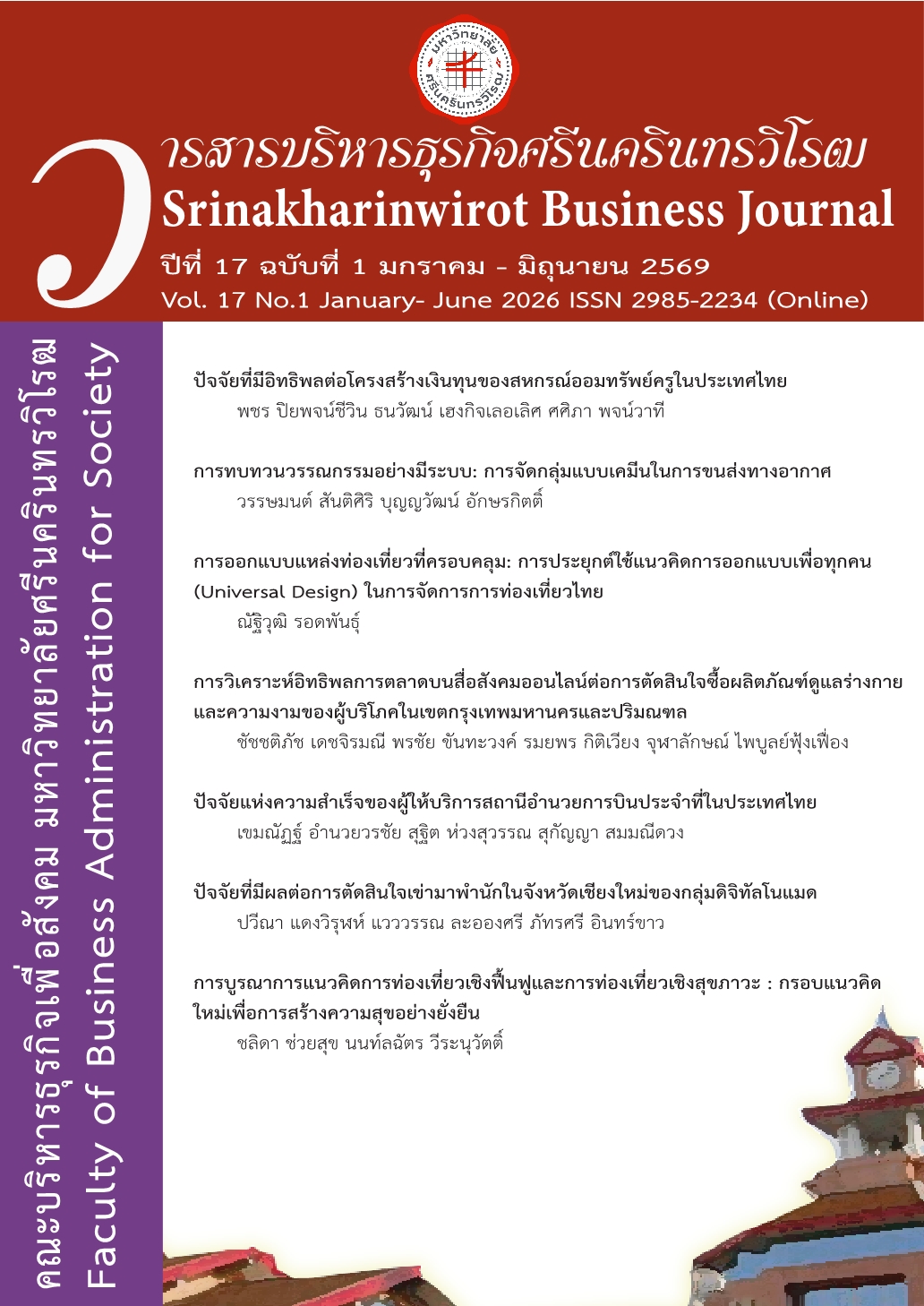
การออกแบบแหล่งท่องเที่ยวที่ครอบคลุม: การประยุกต์ใช้แนวคิดการออกแบบเพื่อทุกคน (Universal Design) ในการจัดการการท่องเที่ยวไทย
Keywords:
Universal Design, Inclusive Tourism, Accessibility, Tourist Destinations, Tourism ManagementAbstract
This article explains and synthesizes approaches to designing inclusive destinations by applying the concept of Universal Design to enhance inclusive tourism in the Thai context, where tourism functions as a key economic and social driver. It begins by underscoring the importance of accessibility for all population groups including older adults, persons with disabilities, children, pregnant women, and the general traveling public, using Universal Design principles as the analytical framework. An integrative literature review and comparative synthesis were then employed. The findings indicate that achieving inclusive tourism requires system-wide action encompassing physical infrastructure, service and digital design, enforceable standards and evaluation, workforce development, clear multi-format accessibility information, and meaningful community and stakeholder participation.
Policy and managerial recommendations include establishing measurable accessibility standards with continuous monitoring, fostering cross-sector collaboration, upgrading service competencies for supporting travelers with specific needs, developing open accessibility information platforms, and using economic incentives to accelerate adaptive investments. In practice, the proposed framework serves as a roadmap for developing destinations that are genuinely accessible to all.
References
กรุงเทพธุรกิจ. (2568, 2 มกราคม). เปิดสถิติปี 2567 ต่างชาติเที่ยวไทย 35.54 ล้านคน ส่อง 10 อันดับเดินทางสูงสุด. https://www.bangkokbiznews.com/business/business/1160350
ชฎิล มาตรา. (2562). นวัตกรรมการบริการของโรงแรมเพื่อรองรับนักท่องเที่ยวผู้สูงอายุที่มาพักแรมในจังหวัดขอนแก่น [รายงานการวิจัย, มหาวิทยาลัยศรีปทุม]. มหาวิทยาลัยศรีปทุม วิทยาเขตขอนแก่น. https://dspace.spu.ac.th/handle/123456789/9078
ประกาศ ปาวา ทองสว่าง, และ สันติธร ภูริภักดี. (2567). การพัฒนาการท่องเที่ยวเพื่อคนทั้งมวลในพื้นที่ระเบียงเศรษฐกิจพิเศษภาคตะวันออก (EEC). วารสาร มจร พุทธปัญญาปริทรรศน์, 9(1), 350–366. https://so03.tci-thaijo.org/index.php/jmbr/article/view/265972
สราญภัทร อนุมัติราชกิจ. (2560). อารยสถาปัตย์ในสังคมไทย: ศึกษากรณีผู้สูงอายุ [เอกสารวิจัยส่วนบุคคล]. วิทยาลัยป้องกันราชอาณาจักร.
องค์การบริหารการพัฒนาพื้นที่พิเศษเพื่อการท่องเที่ยวอย่างยั่งยืน (องค์การมหาชน). (2564, 19 สิงหาคม). ความหมายของ Tourism for All การท่องเที่ยวเพื่อคนทั้งมวล. https://www.dasta.or.th/th/article/695
Domínguez Vila, T., Darcy, S., & Alén González, E. (2015). Competing for the disability tourism market – A comparative exploration of the factors of accessible tourism competitiveness in Spain and Australia. Tourism Management, 47, 261–272. https://doi.org/10.1016/j.tourman.2014.10.008
Fernandes-Ferreira, A., Damaceno-Leite, A., & Chang, S. K. J. (2020). Accessible tourism and the role of public transport provision: Comparing the access to attractions for tourists with and without disabilities in Bangkok. In Resilience and Sustainable Transportation Systems (pp. 19–27). https://doi.org/10.1061/9780784482902.003
Lin, H.-H., Chang, K.-H., Tseng, C.-H., Lee, Y.-S., & Hung, C.-H. (2021). Can the development of religious and cultural tourism build a sustainable and friendly life and leisure environment for the elderly and promote physical and mental health?. International Journal of Environmental Research and Public Health, 18(22), Article 11989. https://doi.org/10.3390/ijerph182211989
Losada, N., Alén, E., Nicolau, J. L., & Domínguez, T. (2017). Senior tourists’ accommodation choices. International Journal of Hospitality Management, 66, 24–34. https://doi.org/10.1016/j.ijhm.2017.06.014
Ministry of Land, Infrastructure, Transport and Tourism. (2018). White paper on land, infrastructure, transport and tourism 2018: Chapter 7 building a safe and comfortable society. https://www.mlit.go.jp/common/001269905.pdf
Moon, H., Jongsik, Y., Chua, B.-L., & Han, H. (2022). Armchair tourism: Exploring individuals’ innovative travel experience in the with-corona era. Tourism Management, 93, Article 104582. https://doi.org/10.1016/j.tourman.2022.104582
Public Relations Office of the Government of Japan. (2021, March). Promoting the barrier-free design of railway facilities. Highlighting Japan. https://www.gov-online.go.jp/eng/publicity/book/hlj/html/202103/202103_05_en.html
Scheyvens, R., & Biddulph, R. (2018). Inclusive tourism development. Tourism Geographies, 20(4), 589–609. https://doi.org/10.1080/14616688.2017.1381985
Somnuxpong, S., & Wiwatwongwana, R. (2020). The ability to support accessible tourism in Chiang Mai, Thailand. African Journal of Hospitality, Tourism and Leisure, 9(1), 1–16. https://www.researchgate.net/publication/340335262_The_ability_to_support_accessible_tourism_in_Chiang_Mai_Thailand
The Standard. (2568, 8 มกราคม). สรุป ‘ท่องเที่ยวไทย 2567’ ดึงดูดต่างชาติ 35.54 ล้านคน โกยรายได้ 1.91 ล้านล้านบาท จับตาอีก 1-2 ปีก็ยังไม่น่าฟื้นสู่ระดับก่อนโควิด. https://thestandard.co/thai-tourism-2024-summary
Tourism Research Australia. (2024). Travellers with accessibility needs in Australia. Austrade. https://www.tra.gov.au/content/dam/austrade-assets/global/wip/tra/documents/travellers-with-accessibility-needs-in-australia.pdf
United Nations. (2018). Disability and development report: Realizing the Sustainable Development Goals by, for and with persons with disabilities. https://www.un.org/development/desa/disabilities/wp-content/uploads/sites/15/2019/10/UN-flagship-report-on-disability-and-development.pdf
World Health Organization. (2015). World report on ageing and health. https://www.who.int/publications/i/item/9789241565042
World Health Organization. (2022). Global report on health equity for persons with disabilities. https://www.who.int/publications/i/item/9789240063600
World Tourism Organization. (2016). Manual on accessible tourism for all: Principles, tools and best practices – Module I: Accessible tourism – Definition and context. https://doi.org/10.18111/9789284418077
World Tourism Organization. (2021). Tourism for inclusive growth. https://www.untourism.int/world-tourism-day-2021
Downloads
Published
How to Cite
Issue
Section
License
Copyright (c) 2026 Srinakharinwirot Business Journal

This work is licensed under a Creative Commons Attribution-NonCommercial-ShareAlike 4.0 International License.
ลิขสิทธิ์ของบทความที่ได้รับการตีพิมพ์ในารสารบริหารธุรกิจศรีนครินทรวิโรฒ เป็นของวารสาร โดยผู้เขียนยินยอมโอนสิทธิ์ในการเผยแพร่และจัดพิมพ์บทความให้แก่วารสาร เมื่อบทความได้รับการตอบรับเพื่อตีพิมพ์ วารสารมีสิทธิ์ในการจัดพิมพ์ เผยแพร่ และจัดเก็บบทความในรูปแบบสิ่งพิมพ์และสื่ออิเล็กทรอนิกส์
ทางวารสารอนุญาตให้นำเนื้อหาไปใช้เพื่อประโยชน์ทางการศึกษาและการวิจัยที่ไม่แสวงหากำไรได้ โดยต้องอ้างอิงแหล่งที่มาอย่างถูกต้องครบถ้วน การนำไปใช้ ดัดแปลง เผยแพร่ซ้ำ หรือใช้ในเชิงพหาณิชย์ ต้องได้รับอนุญาตเป็นลายลักษณ์อักษรจากวารสารก่อน


