The Integration of Regenerative The Integration of Regenerative and Wellness Tourism : A Conceptual Framework for Sustainable Well-being
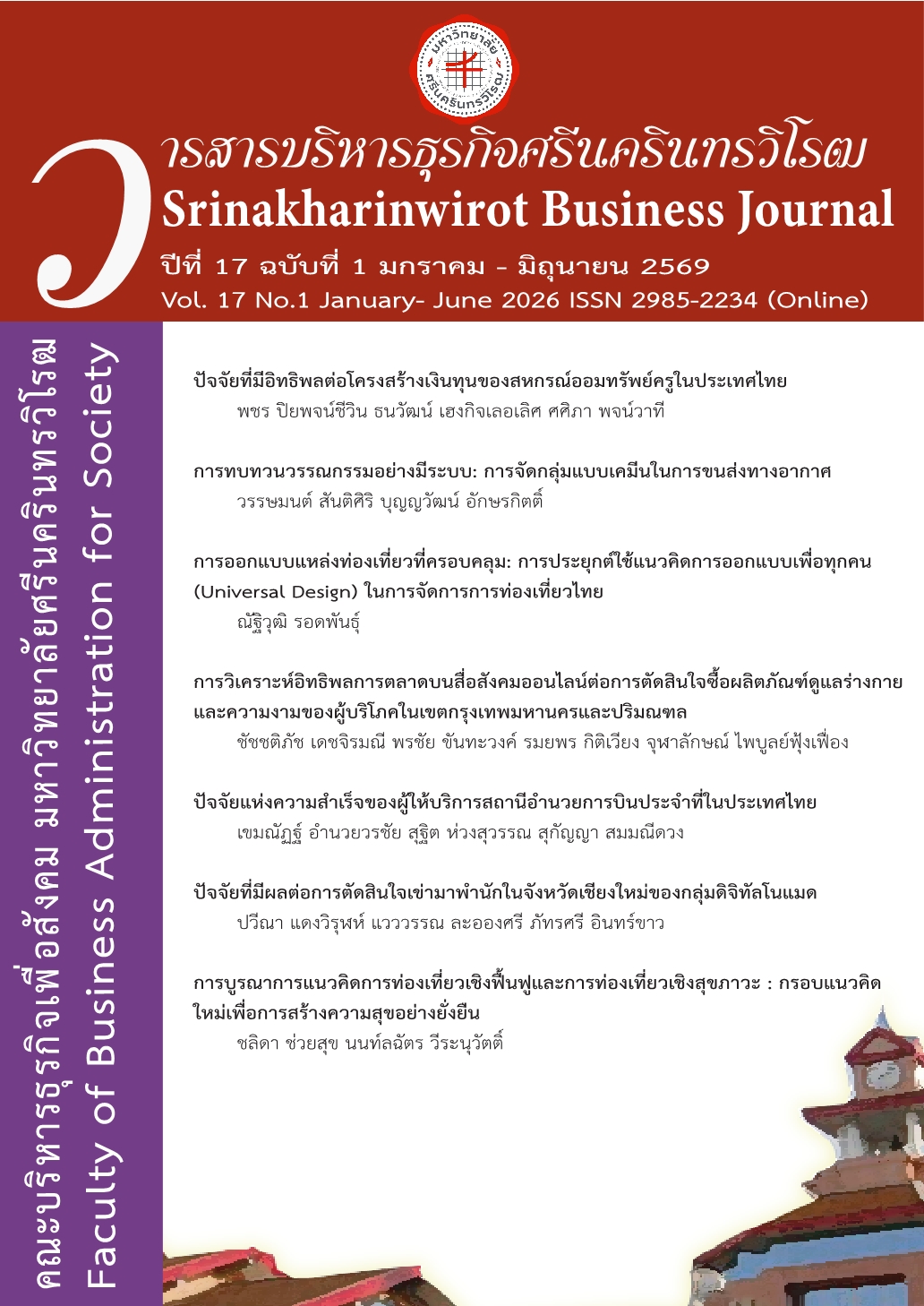
การบูรณาการแนวคิดการท่องเที่ยวเชิงฟื้นฟูและการท่องเที่ยวเชิงสุขภาวะ : กรอบแนวคิดใหม่เพื่อการสร้างความสุขอย่างยั่งยืน
Keywords:
Regenerative Tourism, Wellness Tourism, Sustainable Well-being, Eudaimonic Well-being, Shared Value CreationAbstract
This study aims to synthesize and integrate knowledge from two emerging paradigms: Regenerative Tourism and Wellness Tourism, to propose a novel approach for sustainable tourism management. Employing a systematic literature review methodology, data were analyzed from leading international databases, including Scopus, ScienceDirect, and Taylor & Francis Online, covering the period from 1989 to 2025. The study proposes a conceptual framework termed "Regenerative Wellness Tourism," which is driven by three dynamic dimensions 1) the Personal Dimension, focusing on inner growth through Eudaimonic well-being 2) the Social Dimension, emphasizing the cultivation of reciprocal relationships between tourists and host communities; and 3) the Environmental Dimension, aiming to generate a net positive impact on ecosystems. This framework not only expands the theoretical boundaries of tourism studies but also provides strategic implications for policymakers and practitioners to transition the industry from merely mitigating negative impacts toward creating shared value and achieving authentic regeneration.
References
Ateljevic, I. (2020). Transforming the (tourism) world for good and (re)generating the potential ‘new normal’. Tourism Geographies, 22(3), 467–475. https://doi.org/10.1080/14616688.2020.1759134
Avecillas-Torres, I., Herrera-Puente, S., Galarza-Cordero, M., Coello-Nieto, F., Farfán-Pacheco, K., Alvarado-Vanegas, B., Ordóñez-Ordóñez, S., & Espinoza-Figueroa, F. (2025). Nature tourism and mental well-being: Insights from a controlled context on reducing depression, anxiety, and stress. Sustainability, 17(2), 654. https://doi.org/10.3390/su17020654
Azimi, A., Moradi, E., Yousefi, B., & Hassani, Z. (2025). Bridging theory and practice in healthy aging: The role of wellness tourism in shaping psychosocial outcomes. Acta Psychologica, 257, 105062. https://doi.org/10.1016/j.actpsy.2025.105062
Becken, S., & Kaur, J. (2021). Anchoring “tourism value” within a regenerative tourism paradigm: A government perspective. Journal of Sustainable Tourism, 30, 52–68. https://doi.org/10.1080/09669582.2021.1990305
Bellato, L., Frantzeskaki, N., Briceño Fiebig, C., Pollock, A., Dens, E., & Reed, B. (2022). Transformative roles in tourism: Adopting living systems’ thinking for regenerative futures. Journal of Tourism Futures, 8(3), 312–329. https://doi.org/10.1108/JTF-11-2021-0256
Bellato, L., & Pollock, A. (2023). Regenerative tourism: A state-of-the-art review. Tourism Geographies, 27, 558–567. https://doi.org/10.1080/14616688.2023.2294366
Bowen, G. A. (2009). Document analysis as a qualitative research method. Qualitative Research Journal, 9(2), 27–40. https://doi.org/10.3316/QRJ0902027
Bramwell, B. (2003). Maltese responses to tourism. Annals of Tourism Research, 30(3), 581–605. https://doi.org/10.1016/S0160-7383(03)00023-9
Briassoulis, H. (2003). Crete: Endowed by nature, privileged by geography, threatened by tourism? Journal of Sustainable Tourism, 11(2–3), 97–115. https://doi.org/10.1080/09669580308667198
Brooks, C., Waterton, E., Saul, H., & Renzaho, A. (2023). Exploring the relationships between heritage tourism, sustainable community development and host communities’ health and wellbeing: A systematic review. PLOS ONE, 18(3), e0282319. https://doi.org/10.1371/journal.pone.0282319
Buckton, S. J., Fazey, I., Sharpe, B., Om, E. S., Doherty, B., Ball, P. D., Denby, K., Bryant, M., Lait, R., Bridle, S., Cain, M., Carmen, E., Collins, L. M., Nixon, N., Yap, C., Connolly, A., Fletcher, B., Frankowska, A., Gardner, G. E., James, A., ... Sinclair, M. (2023). The regenerative lens: A conceptual framework for regenerative social-ecological systems. One Earth, 6(7), 824–842. https://doi.org/10.1016/j.oneear.2023.06.006
Chang, X., & Li, Z. (2022). Tourists’ perceived restoration of Chinese rural cultural memory space. Sustainability, 14(22), 14825. https://doi.org/10.3390/su142214825
Chen, C., Lai, Y., & Huo, C. (2025). How do environmental and cultural factors shape red tourism behavioral intentions: A moderated mediation model. Frontiers in Psychology, 16, 1566533. https://doi.org/10.3389/fpsyg.2025.1566533
Dredge, D. (2022). Regenerative tourism: Transforming mindsets, systems and practices. Journal of Tourism Futures, 8(3), 269–281. https://doi.org/10.1108/JTF-01-2022-0015
Duarte, C. M., Cousins, R., Ficociello, M. A., Williams, I. D., & Khowala, A. (2024). Advancing global climate and biodiversity goals through regenerative tourism. Sustainability, 16(20), 9133. https://doi.org/10.3390/su16209133
Dwyer, L. (2020). Tourism development and sustainable well-being: A Beyond GDP perspective. Journal of Sustainable Tourism. Advance online publication. https://doi.org/10.1080/09669582.2020.1825457
Dwyer, L. (2021). Resident well-being and sustainable tourism development: The ‘capitals approach’. Journal of Sustainable Tourism. Advance online publication. https://doi.org/10.1080/09669582.2021.1990304
Dwyer, L. (2023). Why tourism economists should treat resident well-being more seriously. Tourism Economics, 29(8), 1975–1994. https://doi.org/10.1177/13548166221128081
Houlden, V., Weich, S., de Albuquerque, J. P., Jarvis, S., & Rees, K. (2018). The relationship between greenspace and the mental wellbeing of adults: A systematic review. PLOS ONE, 13(9), e0203000. https://doi.org/10.1371/journal.pone.0203000
Jaakkola, E. (2020). Designing conceptual articles: Four approaches. AMS Review, 10(1), 18–26. https://doi.org/10.1007/s13162-020-00161-0
Joshanloo, M., & Weijers, D. (2019). A two-dimensional conceptual framework for understanding mental well-being. PLOS ONE, 14(3), e0214045. https://doi.org/10.1371/journal.pone.0214045
Lazic, S., & Della Lucia, M. (2024). A holistic and pluralistic perspective for justice through tourism: A regenerative approach. Tourism Geographies. Advance online publication. https://doi.org/10.1080/14616688.2024.2372114
Liao, C., Zuo, Y., Xu, S., Law, R., & Zhang, M. (2023). Dimensions of the health benefits of wellness tourism: A review. Frontiers in Psychology, 13Trace, 1071578. https://doi.org/10.3389/fpsyg.2022.1071578
Lin, Z. C. J., Wong, I. A., Kou, I. E., & Zhen, X. (2021). Inducing wellbeing through staycation programs in the midst of the COVID-19 crisis. Tourism Management Perspectives, 40, 100907. https://doi.org/10.1016/j.tmp.2021.100907
Lindell, L., Sattari, S., & Höckert, E. (2021). Introducing a conceptual model for wellbeing tourism: Going beyond the triple bottom line of sustainability. International Journal of Spa and Wellness. Advance online publication. https://doi.org/10.1080/24721735.2021.1961077
Niñerola, A., Sánchez-Rebull, M.-V., & Hernández-Lara, A.-B. (2019). Tourism research on sustainability: A bibliometric analysis. Sustainability, 11(5), 1377. https://doi.org/10.3390/su11051377
Paddison, B., & Hall, J. (2024). Regenerative tourism development as a response to crisis: Harnessing practise-led approaches. Tourism Geographies. Advance online publication. https://doi.org/10.1080/14616688.2024.2381071
Page, M. J., McKenzie, J. E., Bossuyt, P. M., Boutron, I., Hoffmann, T. C., Mulrow, C. D., Shamseer, L., Tetzlaff, J. M., Akl, E. A., Brennan, S. E., Chou, R., Glanville, J., Grimshaw, J. M., Hróbjartsson, A., Lalu, M. M., Li, T., Loder, E. W., Mayo-Wilson, E., McDonald, S., ... Moher, D. (2021). The PRISMA 2020 statement: An updated guideline for reporting systematic reviews. BMJ, 372, n71. https://doi.org/10.1136/bmj.n71
Saayman, M., Li, G., Uysal, M., & Song, H. (2018). Tourist satisfaction and subjective well-being: An index approach. International Journal of Tourism Research, 20(3), 388–399. https://doi.org/10.1002/jtr.2190
Smith, M., & Puczkó, L. (2016). The Routledge handbook of health tourism. Routledge.
Snyder, H. (2019). Literature review as a research methodology: An overview and guidelines. Journal of Business Research, 104, 333–339. https://doi.org/10.1016/j.jbusres.2019.07.039
Suárez-Rojas, C., González Hernández, M. M., & León, C. J. (2023). Sustainability in whale-watching: A literature review and future research directions based on regenerative tourism. Tourism Management Perspectives, 47Trace, 101120. https://doi.org/10.1016/j.tmp.2023.101120
Sun, Y.-Y., Faturay, F., Lenzen, M., Gössling, S., & Higham, J. (2024). Drivers of global tourism carbon emissions. Nature Communications, 15, 10384. https://doi.org/10.1038/s41467-024-54582-7
Tang, R., Zhao, x., & Guo, Z. (2024). Place perception and restorative experience of recreationists in the natural environment of rural tourism. Frontiers in Psychology, 15, 1341956. https://doi.org/10.3389/fpsyg.2024.1341956
Waterman, A. S., Schwartz, S. J., Zamboanga, B. L., Ravert, R. D., Williams, M. K., Agocha, V. B., Kim, S. Y., & Donnellan, M. B. (2010). The Questionnaire for Eudaimonic Well-Being: Psychometric properties, demographic comparisons, and evidence of validity. The Journal of Positive Psychology, 5(1), 41–61. https://doi.org/10.1080/17439760903435208
Xue, L.-L., & Shen, C.-C. (2022). The sustainable development of organic agriculture: The role of wellness tourism and environmental restorative perception. Agriculture, 12(2), 197. https://doi.org/10.3390/agriculture12020197
Zheng, Y., & Wu, Y. (2023). An investigation of how perceived smart tourism technologies affect tourists’ well-being in marine tourism. PLOS ONE, 18(8), e0290539. https://doi.org/10.1371/journal.pone.0290539
Downloads
Published
How to Cite
Issue
Section
License
Copyright (c) 2026 Srinakharinwirot Business Journal

This work is licensed under a Creative Commons Attribution-NonCommercial-ShareAlike 4.0 International License.
ลิขสิทธิ์ของบทความที่ได้รับการตีพิมพ์ในารสารบริหารธุรกิจศรีนครินทรวิโรฒ เป็นของวารสาร โดยผู้เขียนยินยอมโอนสิทธิ์ในการเผยแพร่และจัดพิมพ์บทความให้แก่วารสาร เมื่อบทความได้รับการตอบรับเพื่อตีพิมพ์ วารสารมีสิทธิ์ในการจัดพิมพ์ เผยแพร่ และจัดเก็บบทความในรูปแบบสิ่งพิมพ์และสื่ออิเล็กทรอนิกส์
ทางวารสารอนุญาตให้นำเนื้อหาไปใช้เพื่อประโยชน์ทางการศึกษาและการวิจัยที่ไม่แสวงหากำไรได้ โดยต้องอ้างอิงแหล่งที่มาอย่างถูกต้องครบถ้วน การนำไปใช้ ดัดแปลง เผยแพร่ซ้ำ หรือใช้ในเชิงพหาณิชย์ ต้องได้รับอนุญาตเป็นลายลักษณ์อักษรจากวารสารก่อน


