Home ThaiJO


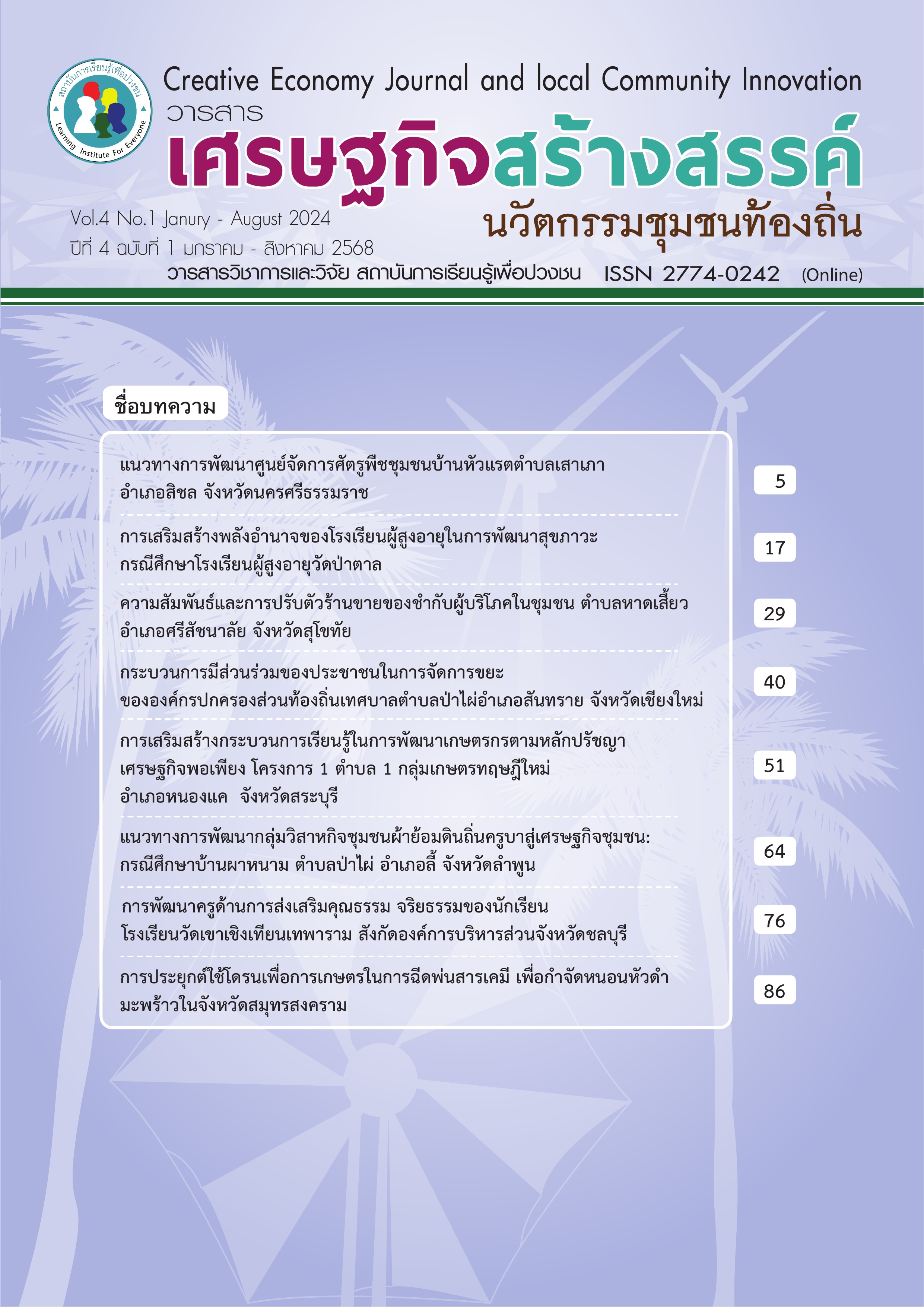
This issue of the journal presents a concrete reflection of grassroots social development through area-based research. The studies featured in this issue cover a wide range of topics, including the empowerment of older persons, community economic development, environmental management, farmers’ learning, the promotion of morality and ethics in educational institutions, and the application of modern technology in agriculture. Collectively, these studies point to a shared principle: “Authentic knowledge must emerge from the context of people’s lives,” while sustainable development must be grounded in meaningful community participation.
Many articles in this issue employ Participatory Action Research (PAR) and qualitative research approaches to co-create knowledge among academics, public agencies, and local communities. These studies go beyond merely examining problems; they involve collaboratively designing processes of change. Consequently, their outcomes extend beyond academic findings to include the development of people’s capabilities, networks, and social institutions in real-world settings.
A notable trend is the integration of three dimensions of knowledge: local wisdom, modern science and technology, and social learning processes. This integration enables communities to move from being “recipients of development” to becoming “co-creators of their own future.” Schools for older persons, community enterprises, local shops, and farming communities have all become spaces for learning and social innovation.
The Editorial Board is pleased to announce that the journal has fully implemented an online journal management system through ThaiJO (Thai Journals Online). This development enhances the standard of academic publishing in accordance with international practices, improves transparency and accountability, and enables researchers to submit manuscripts, track their status, and access scholarly knowledge more conveniently. It will also broaden opportunities for knowledge exchange between academic communities and society at large.
Ultimately, this journal is not merely a platform for publishing academic work but also a forum for collective learning. We sincerely hope that every research article in this issue will extend beyond the printed page and be applied in practice to create value for communities and contribute to the continued advancement of knowledge in Thailand.
The Editorial Board would like to express its sincere appreciation to all authors, reviewers, and readers who have contributed to the continued growth of a learning society.
Home ThaiJO
Visitors
Counter installed: 16 Jan 2026

