Peer Review Process
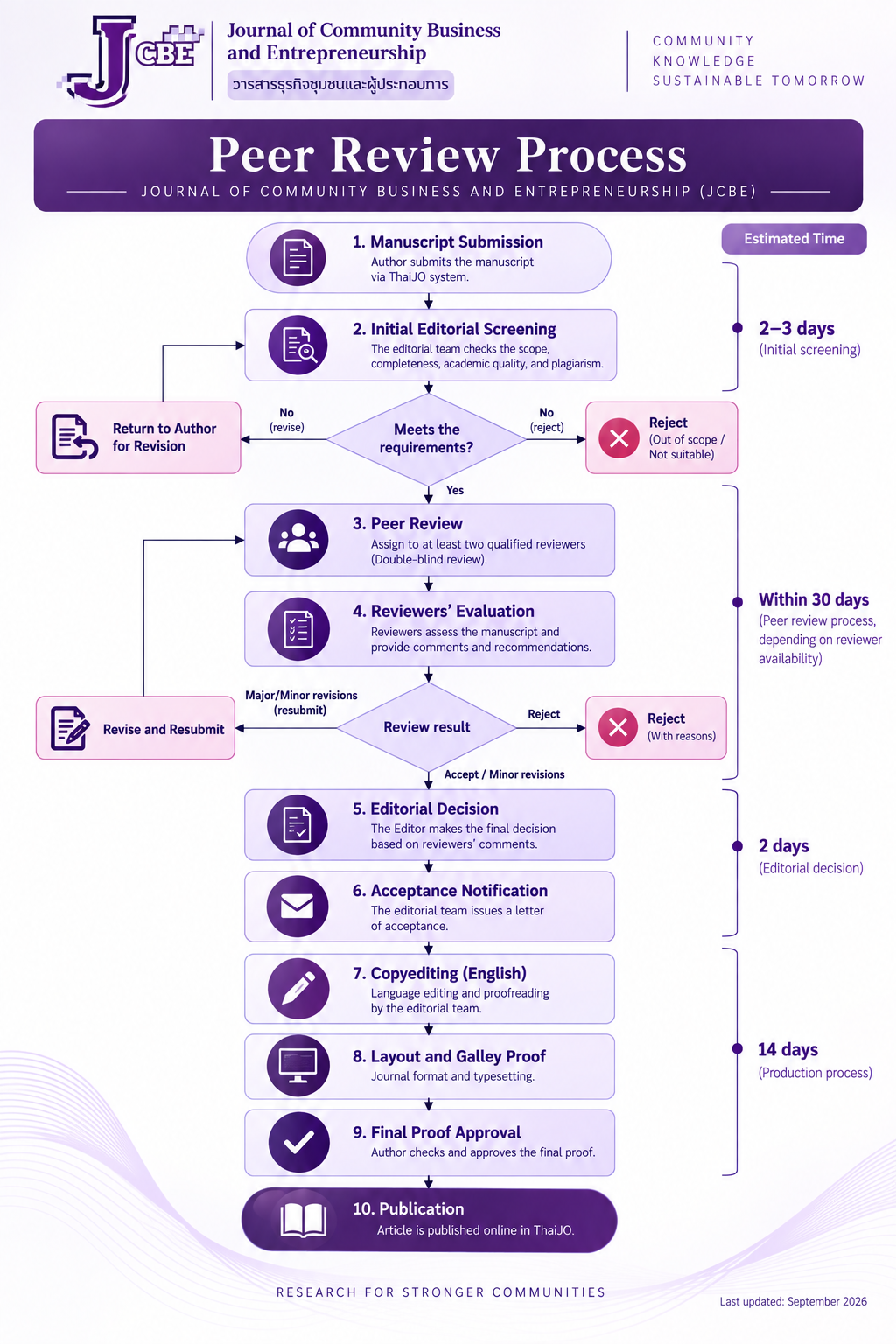
Peer Review Process
The Journal of Community Business and Entrepreneurship (JCBE) employs a double-blind peer-review process to ensure academic quality, fairness, confidentiality, and integrity. Manuscripts that pass the initial editorial screening are evaluated by at least two qualified peer reviewers with expertise relevant to the manuscript’s subject area.
The review and publication process consists of the following stages:
1. Manuscript Submission
Authors submit their manuscripts through the ThaiJO online submission system. Before submission, authors are responsible for ensuring that the manuscript complies with the Journal’s aims and scope, author guidelines, formatting requirements, and publication ethics.
The submitted manuscript should be complete and include all required components and supporting documents specified by the Journal.
2. Initial Editorial Screening
Estimated time: 2–3 days
The Editorial Team conducts an initial screening to determine whether the manuscript is suitable for further consideration.
The screening includes an assessment of:
- relevance to the aims and scope of JCBE;
- completeness of the manuscript;
- compliance with the Journal’s formatting and submission requirements;
- preliminary academic quality and clarity;
- ethical compliance; and
- plagiarism or inappropriate text similarity.
If minor administrative or formatting issues are identified, the manuscript may be returned to the author for revision before proceeding.
Manuscripts that are clearly outside the Journal’s scope, fail to meet basic academic standards, or present significant ethical concerns may be rejected without external peer review.
3. Peer Review
Manuscripts that pass the initial editorial screening are assigned to at least two qualified peer reviewers whose expertise is relevant to the manuscript’s subject area.
JCBE applies a double-blind peer-review system, meaning that the identities of the authors and reviewers are concealed from each other throughout the review process.
Reviewers are selected based on their academic expertise, research experience, and ability to provide an independent and objective assessment. Reviewers are also expected to disclose any potential conflicts of interest before accepting the review assignment.
4. Reviewers’ Evaluation
Estimated time: within 30 days
Peer reviewers evaluate the manuscript based on its academic quality and contribution to the field.
The evaluation normally considers:
- originality and significance of the study;
- relevance to the Journal’s scope;
- clarity of research objectives;
- appropriateness of the research methodology;
- quality of data analysis and interpretation;
- validity of the findings and conclusions;
- quality of discussion;
- contribution to theory, practice, community business, or entrepreneurship;
- appropriateness and accuracy of references; and
- overall quality and clarity of presentation.
Reviewers are expected to provide constructive, specific, and academically justified comments to help authors improve their manuscripts.
Following the review, the manuscript may receive one of the following recommendations:
- Accept;
- Accept with minor revisions;
- Major revisions required;
- Revise and resubmit; or
- Reject.
Reviewer recommendations serve as important academic guidance for the Editor but do not automatically determine the final decision.
5. Revision and Resubmission
If revisions are required, the author must carefully revise the manuscript in accordance with the reviewers’ and/or Editor’s comments.
Authors should submit:
- a revised manuscript; and
- a Response to Reviewers document explaining how each comment has been addressed.
Where an author does not agree with a reviewer’s recommendation, an appropriate academic explanation should be provided.
Depending on the extent of the revisions, the revised manuscript may be reviewed directly by the Editor or returned to the original reviewers for further evaluation.
Major revisions may require more than one round of peer review.
6. Editorial Decision
Estimated time: approximately 2 days after completion of the review process
After considering the reviewers’ reports, the revised manuscript, the authors’ responses, and the Journal’s editorial and ethical requirements, the Editor makes the final decision.
Possible decisions include:
- Accepted for publication;
- Minor revision required;
- Major revision required;
- Resubmit for further review; or
- Rejected.
Where the recommendations of the reviewers differ significantly, the Editor may seek additional clarification or appoint an additional reviewer before making the final decision.
The final decision rests with the Editor.
7. Acceptance Notification
Once a manuscript has successfully completed the peer-review process and has been approved for publication, the Journal issues an official acceptance notification or Letter of Acceptance to the author.
Acceptance confirms that the manuscript has passed the academic review process. However, the article may still require editorial, language, formatting, or production-related corrections before final publication.
8. Copyediting and English Language Editing
After acceptance, the manuscript enters the production stage.
The Editorial Team reviews the manuscript for:
- grammar and language accuracy;
- academic writing style;
- consistency of terminology;
- spelling and punctuation;
- citation and reference consistency;
- tables and figures; and
- compliance with the Journal’s publication format.
Where necessary, English-language editing and proofreading may be undertaken to improve readability and consistency without altering the academic meaning of the article.
9. Layout and Galley Proof Preparation
The manuscript is then formatted according to the official JCBE article template and publication style.
This stage includes:
- page layout and typesetting;
- formatting of headings and subheadings;
- placement of tables and figures;
- formatting of references;
- preparation of article metadata; and
- preparation of the final galley proof.
The production team checks the overall consistency and presentation of the article before sending the proof to the author.
10. Final Proof Approval
The corresponding author is invited to review the final galley proof before publication.
At this stage, authors should carefully check:
- author names and affiliations;
- article title;
- abstract and keywords;
- tables and figures;
- references;
- typographical errors; and
- other production-related details.
Only minor corrections are normally permitted at the proof stage. Substantial changes to the academic content should not be introduced unless approved by the Editor.
The author must confirm approval of the final proof before publication.
11. Publication
Once the final proof has been approved, the article is published online through the ThaiJO platform in accordance with the Journal’s publication schedule.
The published article becomes part of the permanent scholarly record of the Journal of Community Business and Entrepreneurship (JCBE) and is made available to readers through the Journal’s website.




