ความสัมพันธ์ระหว่างสมรรถนะของนักบัญชีเชิงนวัตกรรม ประสิทธิภาพในการดำเนินงาน และความได้เปรียบในการแข่งขันของธุรกิจในจังหวัดยะลา
คำสำคัญ:
Accountant Competency, Operational Efficiency, Competitive Advantageบทคัดย่อ
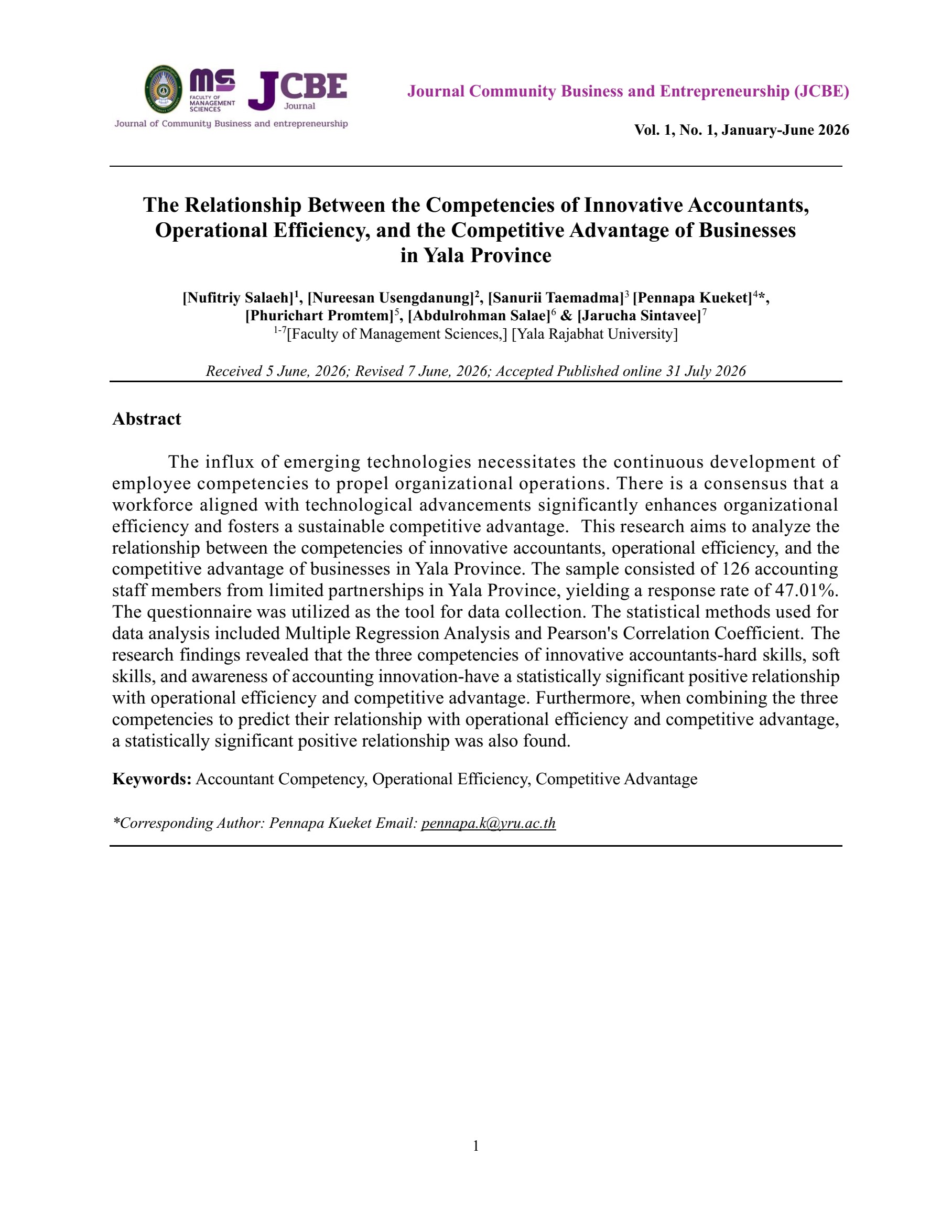
งานวิจัยนี้มีจุดมุ่งหมายเพื่อวิเคราะห์ความสัมพันธ์ระหว่างสมรรถนะของนักบัญชีเชิงนวัตกรรม ประสิทธิภาพการดำเนินงาน และความได้เปรียบในการแข่งขันของธุรกิจในจังหวัดยะลา กลุ่มตัวอย่างประกอบด้วยพนักงานบัญชี 126 คนจากห้างหุ้นส่วนจำกัดในจังหวัดยะลา โดยมีอัตราการตอบแบบสอบถาม 47.01% เครื่องมือที่ใช้ในการเก็บรวบรวมข้อมูลคือแบบสอบถาม วิธีทางสถิติที่ใช้ในการวิเคราะห์ข้อมูล ได้แก่ การวิเคราะห์การถดถอยพหุและสัมประสิทธิ์สหสัมพันธ์ของเพียร์สัน
ผลการวิจัยพบว่า สมรรถนะของนักบัญชีเชิงนวัตกรรมทั้งสามด้าน ได้แก่ ทักษะด้านเทคนิค ทักษะด้านมนุษยสัมพันธ์ และความตระหนักรู้เกี่ยวกับนวัตกรรมทางการบัญชี มีความสัมพันธ์เชิงบวกที่มีนัยสำคัญทางสถิติกับประสิทธิภาพการดำเนินงานและความได้เปรียบในการแข่งขัน นอกจากนี้ เมื่อนำสมรรถนะทั้งสามด้านมารวมกันเพื่อทำนายความสัมพันธ์กับประสิทธิภาพการดำเนินงานและความได้เปรียบในการแข่งขัน ก็พบว่ามีความสัมพันธ์เชิงบวกที่มีนัยสำคัญทางสถิติ
เอกสารอ้างอิง
Aaker, D. A., Kumar, V., & Day, G. S. (2001). Marketing research (7th ed.). John Wiley and Sons.
Appelbaum, D., Kogan, A., Vasarhelyi, M., & Yan, Z. (2017). Impact of business analytics and enterprise systems on management accounting. International Journal of Accounting Information Systems, 25, 29–44 https://doi.org/10.1016/j.accinf.2017.03.003
Armstrong. J. C. & Overton, T. S. (1977). Estimating nonresponse bias in mail surveys. Journal Marketing Research. 14, 396-402.
Arthur, M. B., Claman, P. H., & DeFillippi, R. J. (1995). Intelligent enterprise, intelligent careers. Academy of Management Perspectives, 9(4), 7–20. https://doi.org/10.5465/ame.1995.9512032185
Barney, J. (1991). Firm resources and sustained competitive advantage. Journal of Management, 17(1), 99–120. https://doi.org/10.1177/014920639101700108
Bhimani, A. (2020). Digital data and management accounting: Why we need to rethink research methods. Journal of Management Control, 31(1-2), 9–23. https://doi.org/10.1007/s00187-020-00295-z
Bizarro, P. A., & Dorian, M. (2017). Artificial intelligence: The future of auditing. Internal Auditing, 32(5), 21–35.
Black, K. (2006). Business statistics for contemporary decision marking. (4th ed.). USA: John wiley &Sons.
Chaffey, D., & White, G. (2011). Business information management: Improving performance using information systems (2nd ed.). Pearson Education.
Department of Business Development. (2024). Registered saved entities by province as of December 28, 2025. https://datawarehouse.dbd.go.th
Grant, R. M. (1991). The resource-based theory of competitive advantage: Implications for strategy formulation. California Management Review, 33(3), 114–135. https://doi.org/10.2307/41166
Hair, J. F., Black, W. C., Babin, B. J., & Anderson, R. E. (2010). Multivariate data analysis: A global perspective. Pearson Publishing.
Hitt, M. A., Bierman, L., Shimizu, K., & Kochhar, R. (2001). Direct and moderating effects of human capital on strategy and performance in professional service firms: A resource-based perspective. Academy of Management Journal, 44(1), 13–28. https://doi.org/10.5465/3069334
Indrašienė, V., Jegelevičienė, V., Merfeldaitė, O., Penkauskienė, D., Pivorienė, J., Railienė, A., Sadauskas, J., & Valavičienė, N. (2021). Linking critical thinking and knowledge management: A conceptual analysis. Sustainability, 13(3), Article 1476. https://doi.org/10.3390/su13031476
Kao, T. Y., Yang, M. W., Wu, J. T. B., & Cheng, Y. Y. (2016). Co-creating value with consumers through social media. Journal of Services Marketing, 30(2), 141–151. https://doi.org/10.1108/JSM-03-2014-0112
Kaplan, R. S., & Norton, D. P. (1996). The balanced scorecard: Translating strategy into action. Harvard Business School Press.
Khan, M. S. U., Sophia, J., & Shetty, P. (2025). The evolving role of management accounting in strategic decision-making: A study of contemporary practices in data-driven enterprises. International Journal of Research and Scientific Innovation, 12(6), 1578–1590. https://doi.org/10.51244/IJRSI.2025.120600133
Ellström, P. E., & Kock, H. (2008). Competence development in the workplace: Concepts, strategies and effects. Asia Pacific Education Review, 9(1), 5–20. https://doi.org/10.1007/BF03025821
Littlejohn, A., Beetham, H., & McGill, L. (2012). Learning at the digital frontier: A review of digital literacies in theory and practice. Journal of Computer Assisted Learning, 28(6), 547–556. https://doi.org/10.1111/j.1365-2729.2011.00474.x
Lubis, A. S., Absah, Y., & Lumbanraja, P. (2019). Human resource competencies 4.0 for generation Z. European Journal of Human Resource Management Studies, 3(1), 95–104.
Nunnally, J. C., & Bernstein, I. H. (1994). Psychometric theory. Journal of Psychoeducational Assessment, 17(3), 275–280.
Pan, G., & Seow, P. S. (2016). Preparing accounting graduates for the digital era: A stakeholders’ perspective. European Financial Review, August/September, 16–20.
Park, Y. (2017). 8 digital life skills all children need – and a plan for teaching them. World Economic Forum. https://www.weforum.org/agenda/2016/06/8-digital-skillswe-must-teach-our-children.
Pilipczuk, O. (2020). Toward cognitive management accounting. Sustainability, 12(12), Article 5108. https://doi.org/10.3390/su12125108
Prahalad, C. K., & Ramaswamy, V. (2004). The future of competition: Co-creating unique value with customers. Harvard Business Review Press.
Rufino, H. D., Payabyab, R. G., & Lim, G. T. (2017). Competency requirements for professional accountants: Basis for accounting curriculum enhancement. Review of Integrative Business and Economics Research, 7(3), 116–128.
Rulandari, N., AP, S., & Si, M. (2017). The effect of supervision and professionalism on staff performance at the office of social affairs in East Jakarta administrative city. International Journal of Humanities and Social Science, 7(2), 184–192.
Shaw, A., Liu, O. L., Gu, L., Kardonova, E., Chirikov, I., Li, G., Hu, S., Yu, N., Ma, L., Guo, F., Su, Q., Shi, J., Shi, H., & Loyalka, P. (2019). Thinking critically about critical thinking: Validating the Russian HEIghten® critical thinking assessment. Studies in Higher Education, 45(9), 1–16. https://doi.org/10.1080/03075079.2019.1672640.
Teece, D. J. (2007). Explicating dynamic capabilities: The nature and microfoundations of (sustainable) enterprise performance. Strategic Management Journal, 28(13), 1319–1350. https://doi.org/10. 1002/smj.640.
Tonidandel, S., Braddy, P. W., & Fleenor, J. W. (2012). Relative importance of managerial skills for predicting effectiveness. Journal of Managerial Psychology, 27(6), 636–655. https://doi.org/10. 1108/02683941211252464.
Wongkongkaew, P., Promraksa, E., Donkram, W., & Wongkongkaew, B. (2023). Innovative Accountants in the future. Rom Yoong Thong Journal, 1(1), 102-114.
World Economic Forum. (2020). 10 skills you’ll need to survive the rise of automation. Retrieved October 4, 2025, from https://www.weforum.org/agenda/2018/07/the-skills-needed-to-survive-therobot-invasion-of-the-workplace.
Yamali, F. R. (2017). Pengaruh kompensasi dan kompetensi terhadap komitmen organisasi serta implikasinya pada kinerja tenaga ahli perusahaan jasa konstruksi di Provinsi Jambi. Ekonomis: Journal of Economics and Business, 1(1), 213–222. https://doi.org/10.33087/ekonomis.v1i1.21
Yamane, T. (1967). Statistics: An introductory analysis (2nd ed.). Harper and Row.
ดาวน์โหลด
เผยแพร่แล้ว
รูปแบบการอ้างอิง
ฉบับ
ประเภทบทความ
สัญญาอนุญาต
ลิขสิทธิ์ (c) 2026 วารสารธุรกิจชุมชนและผู้ประกอบการ

อนุญาตภายใต้เงื่อนไข Creative Commons Attribution-NonCommercial-NoDerivatives 4.0 International License.
##default.contextSettings.thaijo.licenseTerms##




